February 10, 2012

By Grace We Have Been Saved; Faith is a Gift of God

For by grace are ye saved through faith; and that not of yourselves: it is the gift of God. --Ephesians 2:8

We Obtain Salvation By Our Lord Jesus Christ (1 Thessalonians 5:9)


Man in his mind often takes credit for his own salvation;
This is vanity and vexation of spirit.


Lead me in Thy truth, and teach me: for Thou art the God of my salvation; on Thee do I wait all the day. (Psalms 25:5)

"For the Son of man is come to seek and to save that which was lost." (Luke 19:10)

"While I was with them in the world, I kept them in Thy name: those that Thou gavest me I have kept, and none of them is lost, but the son of perdition; that the scripture might be fulfilled." (John 17:12)

"Of them which Thou gavest me have I lost none." (John 18:9)

The Parable of the Lost Sheep

By Doyle D. Dewberry, Retired Pastor and Author of Sovereign Grace Baptist Proclaimer
Then drew near unto Him all the publicans and sinners for to hear Him. And the Pharisees and scribes murmured, saying, 'This man receiveth sinners, and eateth with them.' And He spake this parable unto them, saying, “What man of you, having an hundred sheep, if he lose one of them, doth not leave the ninety and nine in the wilderness, and go after that which is lost, until he find it? And when he hath found it, he layeth it on his shoulders, rejoicing. And when he cometh home, he calleth together his friends and neighbours, saying unto them, 'Rejoice with me; for I have found my sheep which was lost.' I say unto you, that likewise joy shall be in heaven over one sinner that repenteth, more than over ninety and nine just persons, which need no repentance.” (Luke 15:1-7)
This is one in a trilogy of parables (the shepherd and the lost sheep, the father and the prodigal son, and the woman and the lost coin) with very much in common. In all three parables, there is the effectual and persistent searching for the lost, which represents one of God’s people, and the finding or return of the object. In heaven there is rejoicing and celebration on the return of the object—the repentance and return of one of God’s elect, or every one of God’s people.

When I look for lost sheep, I am looking for any sheep. When the Lord looks for a lost sheep, He is looking for His own sheep, one of His fold. The sheep that I may find is the one He has been seeking to save, every one of whom He knows by name (John 10:3).

One of our problems in understanding this parable has to do with the “when” of our salvation. We generally think of it as the time when we first believe, but God’s people are those given to Him before the foundation of the world. God sees us as His people before we were ever born, yea, before the world began.

When we believe, it is just our Lord finding us, as this lost sheep, and we are returned to the fold. It is a matter of our status before Adam and before the fall, and after Adam and after the fall. While all men fell with Adam, so also did God’s people, whom He chose before time began:
“Known unto God are all His works from the beginning of the world” (Acts 15:18).
God hath from the beginning chosen you to salvation through sanctification of the Spirit and belief of the truth. (2 Thessalonians 2:13)

For the grace of God that bringeth salvation hath appeared to all men. (Titus 2:11)

For by grace are ye saved through faith; and that not of yourselves: it is the gift of God. (Ephesians 2:8)

Thou art my Father, my God, and the rock of my salvation. (Psalms 89:26)

What is the occasion for this parable? The religious people of the day were complaining because the Lord was receiving and eating with sinners (v. 1-3). The same is true today. We have the religious but lost (even those who appear to be divinely drawn unto the Lord and salvation), who look down upon the poor sinner because they consider themselves not to be sinners. But unless a man sees himself a sinner, and lost, he cannot be saved, for the Lord came to seek and to save the lost sinner.

Who is the shepherd? The Lord Jesus is the Good Shepherd who has come to save His people from their sins (Matthew 1:21) and, yea, even to give His life for the sheep (John 10).

What sheep does Christ look for? The sheep He seeks are they whose names were written in the Lamb’s book of life before the world began and, as a result of the fall by Adam, are His lost sheep. Christ’s sheep will or do believe, and are designated as His Sheep. There are many other sheep in the world, but they are not His sheep. Jesus said of them,
“Ye believe not, because ye are not of my sheep... My sheep hear my voice, and I know them, and they follow me” (John 10:26-27).
Who are the 99 that He has left in the wilderness? They are the found sheep. In Luke’s account of this parable, he only tells us that the 99 were those He left behind while He sought this one lost sheep; in Matthew’s account of the parable, we learn more of the 99—the 99 are they that did not go astray. We do not assume that they are just persons that need no repentance (v. 7), but that they, like all of God’s people, need on-going repentance—it is the self-righteous that think they do not need to repent.

Truly my soul waiteth upon God: from Him cometh my salvation. (Psalms 62:1)

For I am not ashamed of the gospel of Christ: for it is the power of God unto salvation to every one that believeth. (Romans 1:16)

So Christ was once offered to bear the sins of many; and unto them that look for Him shall He appear the second time without sin unto salvation. (Hebrews 9:28)

“For the Son of man is come to save that which was lost. How think ye? If a man have an hundred sheep, and one of them be gone astray, doth he not leave the ninety and nine, and goeth into the mountains, and seeketh that which is gone astray? And if so be that he find it, verily I say unto you, he rejoiceth more of that sheep, than of the ninety and nine which went not astray.” (Matthew 18:11-13)

Here are five important points of this parable, which reveal to us the Lord’s saving of all His sheep:
  1. Our Lord was not seeking just any sheep, but one of His sheep, which was lost. If He had seen 99 other sheep, it would not have deterred Him in His search for the one sheep, which was His, but lost. There were many sheep in the world, but He sought His own.
  2. The Lord seeks that lost sheep, for He goes after that which is lost (v. 4). Remember the words of our Savior who said that He “came to seek and save that which was lost.” Evangelism is no more than our finding those whom the Lord seeks, and while we know them not before, He knows them, has purposed their salvation, and thus He foreknew them and predestined them (Romans 8:28-29).

    Notice also the occasion of His sending His disciples out to gather in His sheep, showing us that salvation was to the Jew first (Romans 1:16), but includes only His lost sheep:
    These twelve Jesus sent forth, and commanded them, saying, “Go not into the way of the Gentiles, and into any city of the Samaritans enter ye not: but go rather to the lost sheep of the house of Israel.” (Matthew 10:5-6)
    The importance of this verse is in what He did not say. He did not say “Go ye to the house of Israel, the lost sheep,” but that they were to go to the lost sheep “of” the house of Israel. They did not go to every Israelite in the land. Paul taught: all of Israel is not of Israel (Romans 9), indicating there is an Israel according to the flesh and one according to the Spirit. A true Jew is not one outwardly, but one inwardly—and circumcision is that of the heart, in the spirit, and not in the letter, whose praise is not of men, but of God (Romans 2:28-29).
  3. The Lord will seek His sheep until He finds it; He is an effectual Shepherd. A good example of this is when the Lord went to Zacchaeus—it was Jesus’ main purpose in going through Jericho. While Zacchaeus was up in the tree where he could see the passing Savior, the Savior came to him, telling him to come down, for he is told, “Today… I must abide at thy house.” This man was a publican (who are cited along with sinners in Luke 15). Publicans were Jews working with the Romans collecting taxes from the people, and hated in Israel, but the Lord loved him.
    And Jesus entered and passed through Jericho. And, behold, there was a man named Zacchaeus, which was the chief among the publicans, and he was rich. And he sought to see Jesus who He was; and could not for the press, because he was little of stature. And he ran before, and climbed up into a sycamore tree to see Him: for He was to pass that way. And when Jesus came to the place, He looked up, and saw him, and said unto him, “Zacchaeus, make haste, and come down; for to day I must abide at thy house.” And he made haste, and came down, and received Him joyfully. And when they saw it, they all murmured, saying, that he was gone to be guest with a man that is a sinner. And Zacchaeus stood, and said unto the Lord: 'Behold, Lord, the half of my goods I give to the poor; and if I have taken any thing from any man by false accusation, I restore him fourfold.' And Jesus said unto him, “This day is salvation come to this house, forsomuch as he also is a son of Abraham. For the Son of man is come to seek and to save that which was lost.” (Luke 19:1-10)
    The sheep was a helpless sheep (v. 5) and therefore lost in the wilderness. He could not come to the fold as other sheep, so the Lord carried him there on His shoulders, as we are told:
    “When He hath found it, He layeth it on His shoulders, rejoicing” (Luke 15:5).
    You will never find sinners coming to Christ before He first comes to them, and no one will enter heaven, as this sheep in the fold, except on the shoulders of the Savior Himself. Salvation is not something that man does for God, but that which God does for man. God is the God of salvation.


    Consider repentance, which is not first of man, but first of God:

  4. Therefore thou art inexcusable, O man, whosoever thou art that judgest: for wherein thou judgest another, thou condemnest thyself; for thou that judgest doest the same things. But we are sure that the judgment of God is according to truth against them which commit such things. And thinkest thou this, O man, that judgest them which do such things, and doest the same, that thou shalt escape the judgment of God? Or despisest thou the riches of His goodness and forbearance and longsuffering; not knowing that the goodness of God leadeth thee to repentance? But after thy hardness and impenitent heart treasurest up unto thyself wrath against the day of wrath and revelation of the righteous judgment of God. (Romans 2:1-9)
  5. The shepherd rejoiced over finding the sheep and sought his friends and neighbors to rejoice with him (v. 6). It is typical of that which takes place in heaven over one sinner that repenteth more than over 99 of the self-righteous that think they need no repentance.

    Keep in mind all three related parables, including the woman who lost the coin (drachma) and the father who lost a son: they represent the triune-Godhead in the salvation of sinners. We have the Father, the Son, and the Spirit represented. The latter may be a little difficult to understand, but the Holy Spirit is like a mother to the Church, even though He is spoken of as in the masculine, He broods over the Church much as He did in creation (Genesis 1:2).
Be it known unto you all, and to all the people of Israel, that by the name of Jesus Christ of Nazareth, whom ye crucified, whom God raised from the dead, even by Him doth this man stand here before you whole. This is the Stone which was set at nought of you builders, which is become the Head of the corner. Neither is there salvation in any other: for there is none other name under heaven given among men, whereby we must be saved. (Acts 4:10-12)

Trust in the Lord with all your heart; and lean not unto your own understanding. In all your ways acknowledge Him, and He shall direct your paths. Be not wise in your own eyes: fear the Lord, and depart from evil. (Proverbs 3:5-7)

Consider also the following, which can be said did not lead to the saving of this sheep!
  1. It was not saved by any law or good works. We are told, “By the deeds of the law there shall no flesh be justified in His sight, and that our salvation is by grace—not of works. Works are for those who are already saved, for we are the workmanship of God, created unto good works.” (Ephesians 2)
  2. It was not saved by seeking the Lord. As it is written, “There is none righteous, no, not one: there is none that understandeth, there is none that seeketh after God. They are all gone out of the way, they are together become unprofitable; there is none that doeth good, no, not one.” (Romans 3:10-12)
  3. It was not saved by praying. Praying is for those already saved. It is so set forth in the Scriptures. When Paul was writing to the Church in Rome, he said, “Likewise the Spirit also helpeth our infirmities: for we know not what we should pray for as we ought: but the Spirit itself maketh intercession for us with groanings which cannot be uttered. And He that searcheth the hearts knoweth what is the mind of the Spirit, because He maketh intercession for the saints according to the will of God.” (Romans 8:26-27)
  4. It was not saved through a witness other than the Shepherd, the Lord Jesus. This is not to say that God’s people are not saved through another witnessing, but it does demonstrate that man is not necessary in the salvation of anyone. Peter brought the message of salvation to the Gentiles (all through the leading of the Lord for him to do so), but the apostle Paul was saved on the road to Damascus by the personal encounter with the Lord Jesus Himself, which was after the Lord’s ascension into heaven!

    We sometimes get the opinion that no one can be saved unless man speaks to him: it is one way, but not the only way. Missionaries sometimes feel that unless they go to a certain country, no one could be saved there, but God has not put the fate of man in man’s hands, but in His own! Many have been saved from reading the Scriptures only (the testimony of this writer), others from reading messages in papers and books. Preaching the gospel is accomplished by publishing as well as proclaiming!
In conclusion, we can say this: that we can learn much of man’s salvation in our Lord’s parable of the lost sheep. The sheep was saved through the efforts of the Good Shepherd who sought the sheep, and sought it until He found it, and carried it home on His shoulders. So it is with the Lord Jesus and the salvation of His people given to Him before the foundation of the world!


The Lord is my strength and song, and is become my salvation. (Psalms 118:14)

"I will seek that which was lost, and bring again that which was driven away, and will bind up that which was broken, and will strengthen that which was sick: but I will destroy the fat and the strong; I will feed them with judgment." (Ezekiel 34:16)

For God hath not appointed us to wrath, but to obtain salvation by our Lord Jesus Christ. (1 Thessalonians 5:9)

Account that the longsuffering of our Lord is salvation. (2 Peter 3:15)


By the Grace of God, Through the Faith of Christ, We Have Been Saved; It Is the Gift of God

For by grace are ye saved through faith; and that not of yourselves: it is the gift of God. --Ephesians 2:8

You can't cram religion down someone's throat: only by the grace of God (and not by our own effort) do we receive faith; it is the gift of God (Ephesians 2:8). The mistake that some Christians make is to preach to people who are not ready, willing and able to receive the message.

"No man can come to the Son except the Father draw him" --John 6:44

We are all sinners: some have been found while others remain lost. A lost sinner must be drawn by God to want to know Christ. God says to us, "Yea, I have loved thee with an everlasting love: therefore with lovingkindness have I drawn thee (Jeremiah 31:3)." Our Creator, knowing the hearts and minds of men, has the sovereign right to choose who He will draw near to Him and when. It's all according to His will and in His time.

When God draws someone near, Christians are the vessels that He uses to reveal the truth about His Word to lost sinners. When we are saved, we desire to proclaim the good news in every place, and we should be prepared to explain the hope we have through the faith of Christ with love, joy, peace, longsuffering, kindness, goodness, faithfulness, gentleness and self-control (the nine "fruit of the Holy Spirit," Galatians 5:22).

And it shall come to pass, that whosoever shall call on the name of the Lord shall be saved. --Acts 2:21

Apart from the amazing grace of God, we cannot find Christ. Grace (unmerited favor) and faith are gifts of God: this is why nobody should boast of faith since there is nothing they did to earn it. If they boast of their own faith, then they are misguided people who mistakenly think that by choosing to believe when other sinners didn't, God reciprocated by making them righteous. God chooses us and calls us for good works (to do good), not because of good works (not because we did good). It is not our own faith, but the faith of Christ that saves us.

Sin is the transgression of the laws of God. No man, other than Christ, is without sin. God, being a righteous judge, requires that sin be paid for; that is, that no sin go unpunished. Yet God, being merciful and knowing that all men sin and fall short of His glory, provided a way for His People to escape the penalty of sin, which is spiritual death. The way to escape the penalty of sin, the death of the spiritual body, is through Christ, who paid the wages (penalty) of sin on the cross for God's People.

Knowing that a man is not justified by the works of the law, but by the faith of Jesus Christ,
Even we have believed in Jesus Christ, that we might be justified by the faith of Christ,
And not by the works of the law:
for by the works of the law shall no flesh be justified.
--Galatians 2:16

A Christian should be a striking likeness of Christ in all ways and by all means so that all may say of him, "He has been with Jesus." A penitent believer has his sins already laid on Christ: he obeys the commandments of God and follows the footsteps of Christ, teaching repentance and forgiveness and helping the Lord save those who are still lost, for it brings the Lord glory when we help Him find His lost sheep. However, we need not worry, for we were chosen by God before the foundation of the world, predestinated for eternal life: the Lord knows them that are His ("mine elect"), and He will bring to faith all for whom Christ died.

Christ says, "For many be called, but few chosen." God calls all of us to salvation—those who ignore the call could care less that they are not chosen—no one is being short-changed, for all true believers will be saved and the unbelievers don't want to be saved. Anyone who comes to Christ will not be cast out. Christ says, "Knock, and it will be opened unto you." If we knock, then we were chosen and called by God.

If we go straight to Christ and hide in His wounds, we shall know our election. If we look to Jesus and believe on Him, we make proof of our election directly, for so surely as we believe, we are elected. Jesus tells us whether we are chosen or not: we cannot find it out in any other way. If we go and put our trust in Him, His answer will be, "I have loved thee with an everlasting love, therefore with lovingkindness have I drawn thee."

There will be no doubt about Him having chosen us when we have chosen Him.

Christ says that the first and greatest commandment is to love God with all our heart, mind, soul and strength. Jesus tells us that the second greatest commandment is to love others as we love ourselves and as He loves us. This includes everyone, whether they believe as we do or not. And Jesus says that we should pray for our enemies and do good to them rather than hate them. But we should take care not to unequally yoke ourselves to unbelievers (in marriage or otherwise), for this will lead to lives of misery.

We cannot truly know the Father without knowing the Son; this is why Jesus tells us: "No one knows the Son except the Father, and no one knows the Father except the Son and those to whom the Son chooses to reveal Him" (Matthew 11:27).

Christ Jesus, the Son of God, says to us with His gentle voice: "Come to me, all you who are weary and burdened, and I will give you rest. Take my yoke upon you and learn from me, for I am gentle and humble in heart, and you will find rest for your souls. For my yoke is easy and my burden is light" (Matthew 11:28-30).

And be found in Him, not having mine own righteousness, which is of the law,
But that which is through the faith of Christ,
The righteousness which is of God by faith.
--Philippians 3:9

It is through Christ that we receive the Spirit of God, the Holy Spirit, which enables us to pardon anyone even as God forgives us. So forgive our enemies today, do not think of ourselves first, and we will come to know God, our Father, as He really is. Then we will pray for those who hate us, love those who curse us, and ask our heavenly Father to fill our enemies with grace and bring them to repentance. We will visit the one who hates us and ask his forgiveness even if he was to blame, thus we will teach him humility by taking the first step, and we will get rid of our own pride in the process and we will increase in love.

Wherefore He is able also to save them to the uttermost that come unto God by Him,
Seeing He ever liveth to make intercession for them.
For such an high priest became us, who is holy, harmless, undefiled, separate from sinners,
And made higher than the heavens;
Who needeth not daily, as those high priests, to offer up sacrifice,
First for his own sins, and then for the people’s:
For this He did once, when He offered up Himself.
--Hebrews 7:25-27


"Believest thou not that I am in the Father, and the Father in me?
The words that I speak unto you I speak not of myself
:
But the Father that dwelleth in me, He doeth the works."
--John 14:10


But by the grace of God I am what I am:
And His grace which was bestowed upon me was not in vain;
But I laboured more abundantly than they all:
Yet not I, but the grace of God which was with me.
--1 Corinthians 15:10


We deserve no rewards, no merit, no crowns that we may boast, for it is all of God. Any faith we have more than another is because God dealt that measure to us, and not because of ourselves. Any work we do greater than any other is because God worked within us more than another. Rather than ask, “What rewards will we get,” we should ask, “What does God will for us to do.” And when we have done it, say, “We are unprofitable servants.” Abandon pride and, as the certain poor widow who threw in two mites, surrender all to our Lord. Everlasting life is all the reward we need. (“Do Christians Receive Rewards in Heaven for their Works on Earth?,” Tony Warren)

The Father Sent the Son to be the Savior of the World

There is salvation only in the blood of Christ.

As a shepherd, Abel sanctified his work to the glory of God and offered a sacrifice of blood upon his altar. The Lord had respect unto Abel and his offering. This early type of our Lord is exceedingly clear and distinct: it clearly manifests the great fact that the Son is coming.

Abel was hated by his brother, hated without a cause. And even so was the Savior: the natural and carnal man hated the accepted Man in whom the Spirit of grace was found and rested not until His blood had been shed.

Abel fell and sprinkled his altar and sacrifice with his own blood, and therein sets forth the Lord Jesus, the Lamb of God, slain by the enmity of man while serving as a priest before the Lord. "The good Shepherd layeth down His life for the sheep." Let us weep over Him as we view Him slain by the hatred of mankind, staining the horns of His altar with His own blood.

The blood of Jesus has a mighty tongue and the importance of its prevailing cry is not vengeance but mercy.


It is precious beyond all preciousness to stand at the altar of our good Shepherd! We see Him bleeding there as the slaughtered priest and we hear His blood speaking peace to all His flock, peace between man and his offended Maker, peace in our conscience, peace between Jew and Gentile, peace all down the ages of eternity for blood-washed men.

Abel is the first shepherd in order of time, but our hearts shall ever place Jesus first in order of excellence. Great Keeper of the sheep, we the people of your pasture bless you with our whole hearts when we see you slain for us.

"His sweat was as it were great drops of blood falling down to the ground." --Luke 22:44

The mental pressure arising from our Lord's struggle with temptation so forced His frame to an unnatural excitement that His pores sent forth great drops of blood which fell down to the ground.

This proves how tremendous must have been the weight of sin when it was able to crush the Savior so that He distilled great drops of blood! This demonstrates the mighty power of His love. This sets forth the voluntariness of Christ's sufferings since, without a lance, the blood flowed freely. No need to put on the leech or apply the knife; it flows spontaneously. No need for the rulers to cry, "Spring up, O well;" of itself it flows in crimson torrents.

If men suffer great pain of mind, apparently the blood rushes to the heart. The cheeks are pale, a fainting fit comes on, and the blood has gone inward as if to nourish the inner man while passing through its trial. But see our Savior in His agony; He is so utterly oblivious of self that, instead of His agony driving His blood to the heart to nourish Himself, it drives it outward to bedew the earth. The agony of Christ, inasmuch as it pours Him out upon the ground, pictures the fullness of the offering which He made for men.

Do we not perceive how intense must have been the wrestling through which He passed, and will we not hear its voice to us? "You have not yet resisted unto blood, striving against sin." Behold the great Apostle and High Priest of our profession, who sweat even to blood rather than yield to the great tempter of our souls.

"Without the shedding of blood is no remission." --Hebrews 9:22

In none of the Jewish ceremonies were sins, even typically, removed without blood shedding. In no case, by no means, can sin be pardoned without atonement. It is clear, then, that there is no hope for us outside of Christ since there is no other blood shedding that is worth a thought as an atonement for sin.

Sin will yield to nothing less potent than the blood of Him whom God has set forth as a propitiation. What a blessing that there is the one way of pardon! Why should we seek another? Persons of merely formal religion cannot understand how we can rejoice that all our sins are forgiven us for Christ's sake. Their works and prayers and ceremonies give them very poor comfort; and well may they be uneasy since they are neglecting the one great salvation, endeavoring to get remission without blood.

My soul, sit down and behold the justice of God as bound to punish sin; see that punishment all executed upon the Lord Jesus, and fall down in humble joy, and kiss the dear feet of Him whose blood has made atonement for you.

It is in vain when conscience is aroused to fly to feelings and evidences for comfort: this is a habit that we learned in the Egypt of our legal bondage. The only restorative for a guilty conscience is a sight of Jesus suffering on the cross. "The blood is the life thereof," says the Levitical law, and let us rest assured that it is the life of faith and joy and every other holy grace.

Oh! how sweet to view the flowing
Of my Savior’s precious blood;
With divine assurance knowing
He has made my peace with God.

Jesus loved us and gave Himself for us.

He had been all night in agony; He had spent the early morning at the hall of Caiaphas; He had been hurried from Caiaphas to Pilate, from Pilate to Herod, and from Herod back again to Pilate. He had, therefore, but little strength left, and yet neither refreshment nor rest were permitted Him. They were eager for His blood and, therefore, led Him out to die, loaded with the cross.

Pilate delivered our Lord to the lictors to be scourged. The Roman scourge was a most dreadful instrument of torture. It was made of the sinews of oxen and sharp bones were inter-twisted every here and there among the sinews: every time the lash came down these pieces of bone inflicted fearful laceration and tore off the flesh from the bone. The Savior was, no doubt, bound to the column, and thus beaten. He had been beaten before, but this of the Roman lictors was probably the most severe. My soul, stand here and weep over His poor stricken body.

Now we see Jesus brought before the priests and rulers who pronounce Him guilty, and we see the great Scapegoat led away by the appointed officers of justice.

  • God Himself imputes our sins to Him.
  • The Lord laid on Him the iniquity of us all.
  • He was made sin for us.
  • He, the substitute for our guilt, bore our sin, represented by the cross, upon His shoulders.
As we look at the cross upon His shoulders, does it represent our sins? There is one way by which we can tell whether He carried our sins or not. Have we laid our hand upon His head, confessed our sins, and trusted in Him? Then our sin lies not on us; they have all been transferred by blessed imputation to Christ, and He bears them on His shoulder as a load heavier than the cross.

Believers in Jesus, can we gaze upon Him without tears as He stands before us, the mirror of agonizing love?

He is at once fair as the lily for innocence and red as the rose with the crimson of His own blood. As we feel the sure and blessed healing which His stripes have wrought in us, does not our heart melt at once with love and grief? If ever we have loved our Lord Jesus, surely we must feel that affection glowing now within our bosoms.

See how the patient Jesus stands,
Insulted in His lowest case!
Sinners have bound the Almighty's hands,
And spit in their Creator's face.

With thorns His temples gor'd and gash'd
Send streams of blood from every part;
His back's with knotted scourges lash'd.
But sharper scourges tear His heart.

"My God, my God, why hast Thou forsaken me?" --Psalms 22:1, Matthew 27:46, Mark 15:34

We here behold the Savior in the depth of His sorrows. No other place so well shows the griefs of Christ as Calvary, and no other moment at Calvary is so full of agony, as that in which His cry rends the air, "My God, my God, why hast Thou forsaken me?"

At this moment physical weakness was united with acute mental torture from the shame and ignominy through which He had to pass; and to make His grief culminate with emphasis, He suffered spiritual agony surpassing all expression, resulting from the departure of His Father's presence. This was the black midnight of His horror; then it was that He descended the abyss of suffering. No man can enter into the full meaning of these words.

Some of us think at times that we could cry, "My God, my God, why hast Thou forsaken me?" There are seasons when the brightness of our Father's smile is eclipsed by clouds and darkness, but let us remember that God never does really forsake us; it is only a seeming forsaking with us, but in Christ's case it was a real forsaking.

We grieve at a little withdrawal of our Father's love, but the real turning away of God's face from His Son, who shall calculate how deep the agony which it caused Him?

In our case, our cry is often dictated by unbelief; in His case, it was the utterance of a dreadful fact, for God had really turned away from Him for a season.

O poor, distressed soul who once lived in the sunshine of God's face but are now in darkness, remember that He has not really forsaken you. God in the clouds is as much our God as when He shines forth in all the luster of His grace. But since even the thought that He has forsaken us gives us agony, what must the woe of the Savior have been when He exclaimed, "My God, my God, why hast Thou forsaken me?"

When Jesus died, the sacrifices were all finished because all was fulfilled in Him and, therefore, the place of their presentation was marked with an evident token of decay.

The old law of ordinances was put away and, like a worn-out vesture, rent and laid aside when Jesus died on the cross. That rent also revealed all the hidden things of the old dispensation: the mercy seat could now be seen and the glory of God gleamed forth above it.

By the death of our Lord Jesus we have a clear revelation of God, for He was "not as Moses, who put a veil over His face." Life and immortality are now brought to light, and things that have been hidden since the foundation of the world are manifest in Him. The annual ceremony of atonement was thus abolished. The atoning blood, which was once every year sprinkled within the veil, was now offered once for all by the great High Priest and, therefore, the place of the symbolical rite was broken up. No blood of bullocks or of lambs is needed now because Jesus has entered within the veil with His own blood. Hence access to God is now permitted and is the privilege of every believer in Christ Jesus.

"I have a Brother in heaven; I may be poor, but I have a Brother who is rich and is a King; and will He suffer me to want while He is on His throne? Oh, no! He loves me; He is my Brother."

Christ knows our wants and sympathizes with us. He was tempted in all points like as we are, yet without sin. In all our sorrows we have His sympathy. Temptation, pain, disappointment, weakness, weariness, poverty—He knows them all, for He has felt all.

Before we can have any right idea of the love of Jesus, we must understand His previous glory in its height of majesty and His incarnation upon the earth in all its depths of shame.

Who can tell us the majesty of Christ? When He was enthroned in the highest heavens He was very God of very God; by Him were the heavens made, and all the hosts thereof. His own almighty arm upheld the spheres; the praises of cherubim and seraphim perpetually surrounded Him; the full chorus of the hallelujahs of the universe unceasingly flowed to the foot of His throne. He reigned supreme above all His creatures; God over all, blessed forever.

Who can tell His height of glory then? And who, on the other hand, can tell how low He descended?

  • To be a man was something.

  • To be a man of sorrows was far more.

  • To bleed and die and suffer, these were much for Him who was the Son of God.

  • But to suffer such unparalleled agony: to endure a death of shame and desertion by His Father, this is a depth of condescending love, which the most inspired mind must utterly fail to fathom.

  • Herein is love! And truly it is love that "passeth knowledge."

We too frequently ascribe the honor of our salvation, or at least the depths of its benevolence, more to Jesus Christ than we do the Father. This is a very great mistake.

What if Jesus came? Did not His Father send Him? If He spoke wondrously, did not His Father pour grace into His lips that He might be an able minister of the new covenant? He who knows the Father and the Son and the Holy Ghost as he should know them never sets one before another in his love.

Are you united with Him? Then believe that you are united unto the God of heaven. Since to the Man Christ Jesus you are brother and hold close fellowship, you are linked thereby with God the Eternal, and "the Ancient of days" is your Father and your friend.

The Father sent Him! Contemplate that subject; think how Jesus works what the Father wills.

“Sanctified by God the Father.” --Jude 1:1
“Sanctified in Christ Jesus.” --1 Corinthians 1:2
“Through sanctification of the Spirit.” --1 Peter 1:2

Mark the union of the three Divine Persons in all their gracious acts. How unwisely do believers talk who make preferences in the Persons of the Trinity, who think of Jesus as if He were the embodiment of everything lovely and gracious, while the Father they regard as severely just but destitute of kindness.

Equally wrong are those who magnify the decree of the Father and the atonement of the Son so as to depreciate the work of the Spirit. In deeds of grace, none of the Persons of the Trinity act apart from the rest. They are as united in their deeds as in their essence. In their love towards the chosen they are one, and in the actions which flow from that great central source they are still undivided. Specially notice this in the matter of sanctification. While we may without mistake speak of sanctification as the work of the Spirit, yet we must take heed that we do not view it as if the Father and the Son had no part therein.

It is correct to speak of sanctification as the work of the Father, of the Son, and of the Spirit. Still does Jehovah say, "Let us make man in our own image after our likeness," and thus we are "His workmanship, created in Christ Jesus unto good works, which God has before ordained that we should walk in them." See the value that God sets upon real holiness since the three Persons in the Trinity are represented as co-working to produce a Church without "spot or wrinkle or any such thing."

And we, believers, as the followers of Christ, must also set a high value on holiness and upon purity of life and godliness of conversation. We must value the blood of Christ as the foundation of our hope, but never speak disparagingly of the work of the Spirit, which is our meetness for the inheritance of the saints in light. This day let us so live as to manifest the work of the Triune God in us.

Jesus had constant fellowship with His Father, and God spoke into His heart so often, so continually, that it was not a circumstance singular enough to be recorded.

It was the habit and life of Jesus to talk with God. Even as Jesus was, is this world, so are we; therefore, let us learn the lesson which this simple statement concerning Him teaches us. May we likewise have silent fellowship with the Father so that often we may answer Him. And though the world knows not to whom we speak, may we be responding to that secret voice unheard of by any other ear, which our own ear, opened by the Spirit of God, recognizes with joy.

God has spoken to us, let us speak to God, either to:
  • Set our seal that God is true and faithful to His promise, or

  • Confess the sin of which the Spirit of God has convinced us, or

  • Acknowledge the mercy which God's providence has given, or

  • Express assent to the great truths that God the Holy Ghost has opened to our understanding.
If we would hear the whispers of God's love, our ear must be purged and fitted to listen to His voice. This very evening may our hearts be in such a state that when God speaks to us, we, like Jesus, may be prepared at once to answer Him.

"Therefore, brethren, we are debtors." --Romans 8:12

As God's creatures, we are all debtors to Him: to obey Him with all our body and soul and strength. Having broken His commandments, as we all have, we are debtors to His justice, and we owe to Him a vast amount, which we are not able to pay.

But of the Christian it can be said that he does not owe God's justice anything since Christ paid the debt that His people owed; for this reason the believer owes the more to love.

I am a debtor to God's grace and forgiving mercy, but I am no debtor to His justice, for He will never accuse me of a debt already paid. Christ said, "It is finished!," and by that He meant that the punishment of death that His people owed for their sins was wiped away forever from the book of remembrance. Christ, to the uttermost, has satisfied divine justice; the account is settled, the handwriting is nailed to the cross, the receipt is given, and we are debtors to God's justice no longer.

But then, because we are not debtors to our Lord's justice, we become ten times more debtors to God than we should have been otherwise.

Christians, pause and ponder for a moment: what debtors we are to divine sovereignty! How much we owe to His immeasurable love, for He gave His own Son that He might die for us. Consider how much we owe to His forgiving grace: after ten thousand affronts He loves us as infinitely as ever.

Consider what we owe to His power, how:
  • He has raised us from our deaths in sin,

  • He has preserved our spiritual lives,

  • He has kept us from falling, and

  • Though a thousand enemies have beset our paths, we have been able to hold on our way.
The eternal God is thy refuge, and underneath are the everlasting arms:
And He shall thrust out the enemy from before thee;
And shall say, "Destroy them." --Deuteronomy 33:27


But the Lord said unto him, "Go thy way: for he is a chosen vessel unto me,
Too bear my name before the Gentiles, and kings, and the children of Israel:
For I will shew him how great things he must suffer for my name's sake." --Acts 9:15-16



God had a couple of interesting questions for Satan in the first chapter of the book of Job. God asked Satan, "Where have you come from?" Satan responded, "From roaming through the earth and going back and forth in it." Certainly the omniscient Lord knew where Satan had been and what he had been up to; the ensuing conversation bears that out. Evidently, Satan and his demonic angels were looking for someone to accuse, devour and destroy, probably someone with weaknesses. God asked Satan if he had considered His servant, Job; however, Satan did not want to consider Job because he was a righteous man. God challenged the devil to attempt to tempt Job, knowing that he would be faithful until the end. Certainly, Satan had been doing just as the New Testament says, prowling about like a roaring lion, seeking to devour. We must be strong like Job, and repent and hold fast till our Lord returns. We must resist the devil so he will flee from us. We must pray for our Lord to lead us not into temptation; but if temptation be permitted, to deliver us from evil.


Put on therefore, as the elect of God, holy and beloved, bowels of mercies, kindness, humbleness of mind, meekness, longsuffering; forbearing one another, and forgiving one another, if any man have a quarrel against any: even as Christ forgave you, so also do ye. And above all these things put on charity, which is the bond of perfectness. And let the peace of God rule in your hearts, to the which also ye are called in one body; and be ye thankful. Let the word of Christ dwell in you richly in all wisdom; teaching and admonishing one another in psalms and hymns and spiritual songs, singing with grace in your hearts to the Lord. And whatsoever ye do in word or deed, do all in the name of the Lord Jesus, giving thanks to God and the Father by Him. --Colossians 3:12-17

And above all things have fervent charity among yourselves: for charity shall cover the multitude of sins. -1 Peter 4:8

February 7, 2012

$200 Dollar Per Barrel of Oil and $7 Per Gallon of Gas

Oil Prices Will Rise Regardless of What Happens with the Stock Market

If past statements from him and his administration are any indication, the U.S. could be stuck (absent major legislative and regulatory changes) with prohibitively high gasoline prices: Then-Senator Obama said on the campaign trail in 2008 that he doesn’t object to high oil prices as long as they come about gradually, and Secretary of Energy Steven Chu once famously said he hoped the U.S. would “boost the price of gasoline to the levels in Europe,” where prices are currently about $7 per gallon. [Top Five Things Obama Has Done to Raise Gasoline Prices, American Solutions, January 3, 2011]

I think by now everyone realizes that "green" and environmental" is the code word for loss of freedom and Socialism. Obama is typing up resources and forcing the cost of food and energy to skyrocket. He and others are engaged in a fierce economic sabotage of this country. Chu (Obama's energy secretary) testified to Congress that Obama and he would like to see gas prices go to $8 per gallon to FORCE Americans into the "Green" initiative -- electric cars, solar and wind. Problem is, planes, trains and automobiles can't efficiently use any of these. And just like ethanol, the results of trying and pushing these failed experiments means disaster to this country. He is subsidizing GE with millions if not billions in "clean energy" money. Jeffrey Imelt made millions in bonuses and GE made $18 billion in profits, but paid no taxes. This criminal of a "president" is waging war on America, and Americans, for greed and power. [justintime]

President Obama's fiscal year 2010 EPA budget calls for carbon reductions that would require raising the cost of gasoline to $7 per gallon within the next 10 years. A report released this month by Harvard University's Belfer Center for Science and International Affairs explained that for Obama to reach his goal, he would need to employ a one-two punch approach, hitting both utility and transportation sectors with strong emissions-reducing taxes. [Source]

Obama promised/told us when he was campaigning (the campaigning BEFORE he was elected, not the current continuing campaign) that he saw no reason why we in the U.S. shouldn't be paying $7 a gallon like Europe, and the best way to force U.S. citizen to 'conserve' was to get prices to that price. He's still working on that: illegally ordered a halt to our drilling in the gulf...until all our oil rigs departed for friendlier countries. He's doing everything he can to keep us from using the massive amounts of oil we have in the country (the Bakken in ND, to name just one of many). I still think he's either an idiot or a traitor...and I lean toward the latter. [Hardcase, Obama sees no magic bullet to push down gas prices, Yahoo! News, April 23, 2011]

The global elite are conspiring to send oil prices crashing through the $200 dollar a barrel mark as part of an organized agenda to hike profits, bring about a global economic crash and torpedo the middle class. [Steve Watson, Oil Continues Steady Climb, Infowars, January 5, 2011 ]

Higher gas prices will force people into the cities where they can be easily monitored and controlled. Rents are going higher in the cities while homes in the suburbs are abandoned. This is Agenda 21.

Much could be done to increase the global supply of oil, but so far our politicians and the major oil company executives are sitting on their hands. They seem to like the increasing oil prices. According to Energy Analyst Peter Beute: Every penny increase at the pump takes $4 million per day from the American consumer. So a 10-cent increase is $40 million a day. [People of Earth: Prepare for Economic Disaster (Excerpt), The Economic Collapse, March 5, 2011]

So for now it looks like oil prices will continue to rise, and this is going to result in much higher prices at the gas pump. Already, ABC News is reporting that regular unleaded gasoline is going for $5.29 a gallon at one gas station in Orlando, Florida. A $10 increase in oil prices translates into roughly a 25 cent increase in retail gasoline prices. [People of Earth: Prepare for Economic Disaster (Excerpt), The Economic Collapse, March 5, 2011]

Fighting in the Middle East is not the cause of rising oil prices. The rising cost of oil is due to the Wall-street traders speculation. If you take oil and gas off of the commodities trading list it would stabilize. We can thank our own greedy government for allowing this to happen. [Don G. at Yahoo! News]

When the gas prices are driven up by artificial shortages claimed by foreign interest, you increase domestic production so as not to let your nation suffer at the hands of foreign tyrants that Obama has bowed to. We don't even have to talk drilling yet or more refineries. Our wells are being subsidized to not pump at capacity and refineries are being regulated back to around 60-70% of their optimum output. Taxpayers are paying for thousands of wells in the U.S. to sit idle and not pump oil and for refineries in Texas and other states to sit dormant while communities go without jobs. Obama said he liked high gas prices because they made selling the fraud of Global Warming easier. [Andy Anderson]

Windmills, solar panels, ethanol are all LIES for the dunces in this country to latch on to and lead us to poverty. They produce less than 1% of our power now...even if we were able to get 10X the production out of them (which is practically impossible) we would still need 90% from conventional sources -- which this president is hell bent on shutting down. The Road to Serfdom -- we're on it following an imposter. [Obama Says Nuclear Power Will Be a Part of the U.S.'s Long-term Energy Plan]

Now the president is repackaging cap-and-trade -- again -- as a long-term solution to the oil spill. But it's the same old agenda, a huge energy tax that will raise the cost of gasoline and electricity high enough so that we're forced to use less. The logic linking cap-and-trade to the spill in the Gulf should frighten anyone who owns a car or truck. Such measures force up the price at the pump -- Harvard Kennedy School's Belfer Center for Science and International Affairs thinks it "may require gas prices greater than $7 a gallon by 2020" to meet Obama's stated goal of reducing emissions 14 percent from the transportation sector. [$7-a-Gallon Gas?, New York Post, June 18, 2010]

Numerous auto industry executives are cited as suggesting that the government raise taxes on gasoline substantially to spur the adoption of fuel efficient vehicles. States Tim Leuliette, chief executive of privately held parts supplier Dura Automotive, said: “In the United States, we’re afraid to touch the fuel price. We’ve got to continue to raise taxes in the United States so that, by the end of the next decade, gas is about $8 a gallon in today’s terms. What you have to do is do it in a manner that is slow enough and predictable enough that vehicle selection and choices by people over the cycle can be made in a logical way. [Auto Execs Urge Government to Tax Fuel Up to $8/Gallon to Increase Fuel Efficiency, DailyTech, November 7, 2009]


$9 Gallon Gasoline Will Crash World Economies If WW3 Starts: Greg Hunter Reports 1/2

Federal Employee in Government Vehicle Uses Taxpayer Funds to Buy Gas at the One Station in DC that Charges $5 per Gallon

You have to wonder if the owner of this station is in cahoots with bureaucrats to fleece the taxpayers

HotAir.com
February 23, 2012

In my neighborhood, we haven’t yet reached $4-per-gallon prices for gasoline, but we’re starting to approach that level. In California, they’ve been paying that price for quite some time. However, Nicholas Ballasly finds the highest price for gasoline right where it would be the most popular — Washington DC:

As the national average price for a gallon of gas climbs past $3.58, one gas station in Washington, D.C. is charging drivers $5.00.

No owners or managers were available at the Exxon station at 2708 Virginia Avenue in Northwest D.C. when The Daily Caller arrived to ask about the $5,00 price.

“You have to ask the owner, you know, the company,” said one worker.

“It’s going to go up to 6 dollars soon, man,” another worker in the repair shop told TheDC.
In case you wonder why high gas prices should be the most popular in Washington DC, don’t forget that Barack Obama himself said during his 2008 presidential campaign that he wanted higher prices to force consumers to use less gasoline, only he preferred a more 'gradual adjustment':


And let’s not forget now-Energy Secretary Stephen Chu’s declaration a couple of months later that he wanted to see the price of gas in the US look a lot like the price of gas in Europe:
President Barack Obama’s Energy secretary unwittingly created a durable GOP talking point in September 2008 when he talked to The Wall Street Journal about the benefits of having gasoline prices rise over 15 years to encourage energy efficiency.

“Somehow,” Chu said, “we have to figure out how to boost the price of gasoline to the levels in Europe.”
Well, this administration is getting exactly what it wants. And it’s getting it by refusing to allow for expanded American production of oil and blocking natural gas extraction, while using the EPA to declare war on coal and coal-fired power plants. They wanted escalations in energy prices in order to punish the use of energy and force people to use less, while artificially making their green-tech alternatives more attractive in comparison. The result? Rapidly escalating gas prices, which will push an inflationary cycle similar to what we saw in 2008 and 2011, which will kill economic growth and wipe out buying power for the working classes.

That’s exactly what Obama promised us. On this promise, he’s delivering.

Suitably Flip notes that it won’t get much better, either:

February is not typically a month when we see energy prices cresting. Instead, prices tend to rise as we get into the summer driving months (and, inconveniently, as we enter the general election season). Over the last six years, crude oil climbed an average of 44% from its late February level before reaching its calendar year high (on average, it took about six months to get there).

A similar run-up from this week’s average of more than $105/barrel would have us cruising past $150 by the end of August, surpassing the record weekly average price seen during the 2008 oil bubble. …

If this were to play out, $6 a gallon might start to sound pretty good.
Be sure to check out the chart, too.

Gas Prices May Reach $7 Per Gallon

The New American
March 8, 2010

President Obama's fiscal year 2010 EPA budget calls for carbon reductions that would require raising the cost of gasoline to $7 per gallon within the next 10 years. A report released this month by Harvard University's Belfer Center for Science and International Affairs explained that for Obama to reach his goal, he would need to employ a one-two punch approach, hitting both utility and transportation sectors with strong emissions-reducing taxes.

The Belfer Center report, Reducing the U.S. Transportation Sector's Oil Consumption and Greenhouse Gas Emissions, criticizes Obama's current plan as short-sighted.

"Reducing oil consumption and carbon emissions from transportation is a much greater challenge than conventional wisdom assumes," warns the report.
It also says subsidies for alternatives such as electric and hybrid vehicles are "extremely expensive and ... ineffective" in the short term.

But don't let their criticisms fool you. The authors of the report call for aggressive climate change policies and illogically conclude,

"Even under high-fuels-tax, high-carbon price scenarios, losses in annual GDP, relative to business-as-usual, are less than 1 percent, and the economy is still projected to grow at 2.1 – 3.7 percent per year assuming a portion of revenues collected are recycled to taxpayers."

Ignoring recent revelations that EPA's greenhouse-gas "endangerment finding" is based on fraudulent data, the report proposes several scenarios which the authors claim will reduce so-called emissions from the transportation sector without significant harm to the economy. The scenarios involve an economy-wide carbon dioxide tax set at $30 per ton in 2010 and escalating to $60 per ton in 2030. The Belfer Center says it would be "a surrogate for a cap-and-trade system like that proposed in the pending American Clean Energy and Security Act." The reference is to H.R. 2454, passed by the House last June and now before the Senate in the form of S. 1733. Many Democrats have suffered in the polls because of their support of these bills, leading Obama to begrudgingly admit final passage is unlikely.

Harvard's solution (in characteristic socialist fashion) is adding to a cap-and-trade tax one or more of the following:

  1. Income tax reductions to offset the burden of a carbon tax on consumers. The authors note there is no such provision in the American Clean Energy and Security Act, but claim including it would significantly reduce economic impacts.
  2. A "strong" gasoline and diesel tax of $0.50 per gallon this year, increasing by 10 percent per year to reach a $3.36 per gallon tax in 2030.
  3. Improvements in Corporate Average Fuel Economy (CAFE) standards to 43.7 miles per gallon by 2030.

The authors argue an economy-wide carbon tax alone would provide little incentive to the transportation sector to curb emissions. Electric utilities would be more adversely affected since they rely more heavily on coal. Therefore, the suggested "additions" listed above are necessary because taxing consumers is the only way to reduce oil consumption and its accompanying greenhouse gas emissions.

The report advises if Obama wants to reduce both emissions and petroleum imports, "consumers cannot continue to drive more and more each year." That is why, according to the authors, electric and hybrid vehicles don't measure up — they only encourage more driving. The report argues,

"The most effective policy for reducing CO2 emissions and oil imports from transportation is to spur the development and sale of more efficient vehicles with strict efficiency standards while increasing the cost of driving with strong fuel taxes."

It ends with the ominous warning that greenhouse gas emissions will continue to grow if the report's suggestions go unheeded.

Auto Execs Urge Government to Tax Fuel Up to $8/Gallon to Increase Fuel Efficiency

DailyTech
November 7, 2009

It’s no secret that when gas prices dropped early in the year and with the recession in full swing, hybrid sales saw their first drop in years. Faced with tough new fuel economy restrictions, auto executives had come up with all sorts of unusual suggestions — such as cutting crash testing — but now had to puzzle over a new dilemma; what if consumers don’t want the higher-priced electric vehicles that they plan to start flooding the market with in less that a year?

At a special Reuters summit in Detroit, numerous auto industry executives are cited as suggesting that the government raise taxes on gasoline substantially to spur the adoption of fuel efficient vehicles.

States Tim Leuliette, chief executive of privately held parts supplier Dura Automotive, said:
“In the United States, we’re afraid to touch the fuel price. We’ve got to continue to raise taxes in the United States so that, by the end of the next decade, gas is about $8 a gallon in today’s terms.”

He adds, "What you have to do is do it in a manner that is slow enough and predictable enough that vehicle selection and choices by people over the cycle can be made in a logical way."
Eight dollars-per-gallon gas? The idea certainly sounds absurd. However, the idea of the government pouring over $100B USD into the auto industry and partially nationalizing GM and Chrysler might have sounded ridiculous a decade ago too.

Mike Jackson, chief executive of AutoNation Inc., offered similar sentiments, complaining:
"The U.S. allows the price of gasoline to go back and forth across this line where the consumers don't care about fuel efficiency and where consumers do care about fuel efficiency."
He suggests a near term fix of taxing gas to around $4 or $5 a gallon to help vehicles like GM's 2011 Chevy Volt EV grab marketshare. Jerry York, a former GM board member and an adviser to billionaire investor Kirk Kerkorian, concurred. He states:
"Unless gas is $3.50 or $4 a gallon, consumers are not going to want to buy those cars."
Hearing such pleas for government intervention and taxation certainly seems a strange one coming from the business sector, which normally argues and lobbies for minimal government involvement. However, a growing number of industry executives feel that a $25B USD advanced technologies loan program and the expensive cash-for-clunkers program just aren't doing enough to boost the sales of clean autos. The solution, they argue, is for the government to hit consumers where it hurts -- in the wallet.

Some are suggesting tax rebates at the end of the year for customers with hybrids and a food-stamp-like subsidy for poor citizens. But at the end of the day the general message is the same; tax fuel. Concludes Dura's Leuliette:
"Energy independence in this country ultimately means that fuel has to be more expensive."

Military Attack on Iran is Essential for the Globalists to Kick-start an Economic Collapse Coupled with a Massive Hike in Oil Prices

Elitists use peak oil scam, market turmoil, threat of Iran war to hike profits, torpedo middle class

Prison Planet
September 17, 2007

The global elite are conspiring to send oil prices crashing through the $200 dollar a barrel mark as part of an organized agenda to hike profits, bring about a global economic crash and torpedo the middle class, and they're not afraid to attack Iran as a means of achieving their goal.

Crude oil prices returned to near record high prices today after having surged past the $80 a barrel benchmark on Thursday.

Now there is serious debate about oil crashing not just the $100 dollar, but the $200 dollar a barrel level in the next two years.

The 24/7 Wall Street blog, which is affiliated with both Dow Jones' MarketWatch and The Wall Street Journal, carried an article over the weekend that entertained the possibility of oil tipping the $200 mark, citing experts in the industry who expect the $95 a barrel level to be surpassed by the end of the year if the recent stock market turmoil continues.

The ultra-secretive Bilderberg Group, a consortium of power brokers from banking, business, politics, academia and oil, met in Munich Germany in May 2005 when crude oil prices were around the $40 a barrel mark.

During the conference, Henry Kissinger told his fellow attendees that the elite had resolved to ensure that oil prices would double over the course of the next 12-24 months, which is exactly what has happened.

During their 2006 meeting in Ottawa Canada, Bilderberg agreed to push for $105 a barrel before the end of 2008. This information was gleaned from sources inside Bilderberg who have proven reliable in the past.

Though Bilderberg claim they are merely a talking shop and formulate no policy, they were also responsible for the decision to delay the invasion of Iraq until March 2003 after it was initially intended to take place in late 2002.

Bilderberg have sworn to bring about what Jose Barroso, President of the European Commission and a Bilderberg member, refers to as the "post-industrial revolution," which in layman's terms translates as a global economic crash, another great depression and the total evisceration of the middle class.

This will be accomplished by hyping the doomsday threat of global warming in alliance with the promotion of peak oil.

Peak oil is a scam manufactured by the oil companies to create artificial scarcity and drive up profits for transnational oil cartels. It was first originated in 1956 by Shell Oil's M. King Hubbert, who said that only one and a quarter trillion barrels of crude were left, a figure that was surpassed at the end of 2006. According to Hubbert's original calculations, the planet should already have produced its last drop over nine months ago.

By pushing peak oil theories and tying them in with the man-made global warming fraud, Bilderberg seeks to jack up oil prices to the point where the living standards of the middle class become unsustainable and the west is lowered into second world status while fat cat elitists reap the financial and political bounty.

A military attack on Iran is also essential for the globalists to kick-start an economic collapse coupled with a massive hike in oil prices. French Foreign Minister Bernard Kouchner told a French TV station yesterday that the world should prepare for war with Iran as rhetoric around the possibility of conflict grows bellicose.

Experts have predicted that should an attack occur, Iran would immediately cease oil exports, pushing the price per barrel well beyond $100 almost immediately, inflating gasoline prices and kicking off a worldwide energy crisis and a recession.

Oil Prices Rise Amid Global Economic Worries

The Washington Post
November 24, 2011

...The Energy Information Administration said this week that the average retail price of regular gasoline is the highest ever recorded during Thanksgiving week, 49 cents a gallon more than this time last year. AAA says this year motorists are on track to pay a record $490 billion for gasoline, burning a hole in consumers’ pockets.

Recently, prices at the gas pump have tapered off. AAA says that gasoline prices have dropped about 12 cents in the past month to a nationwide average of $3.33 a gallon for regular, giving holiday motorists some reason to give thanks.

But this season is usually a period of relatively weak gasoline demand, and retail gasoline prices are still high by historical standards in the United States. Although U.S. motorists seem to change their driving habits most when gas prices near $4 a gallon, the EIA statistics show that consumption this month has been as low as or lower than any November since early in the previous decade.

Moreover, the prices of other petroleum products have been heading higher. With cold weather starting to set in, home heating oil prices stood at $3.94 per gallon as of Nov. 21, an increase of 83 cents a gallon from a year earlier, the EIA said. The higher prices will primarily affect homeowners in New England, where heating oil is still commonly used.

Diesel prices have climbed, which analysts said was a sign of improved economic activity and constraints on refiners because of the government’s low sulfur requirements. A recent Barclays Capital report said that total miles driven by U.S. truckers was up 3.5 percent over the year before.

Diesel prices Wednesday stood at $3.98 a gallon, up 13 cents from a month ago and up 80 cents from a year ago, AAA said. Diesel prices, closely linked to the trucking business, suggest a disconnect between the economy and the glum mood of consumers.

“The sentiment indicators are gloomy, but the production indicators are pretty good,” said Adam Sieminski, chief energy economist at Deutsche Bank. “If you add up what consumers are spending, the numbers are higher than last year. If you ask them how they feel, they say ‘terrible.’ ”

Behind the retail prices of petroleum products lies a global crude market that is still roiled by geopolitical turmoil and economic uncertainty.

The benchmark West Texas Intermediate crude oil this year has averaged more than $94 a barrel, only slightly below the record year of 2008 before the recent recession, and nearly 50 percent more than levels just five years ago. The more widely used benchmark Brent crude in London has cost more than $100 a barrel since early February. On Wednesday, it fell $1.81, or 1.7 percent, to $107.22 a barrel for January delivery after pessimistic economic signs in Europe.

[...]

Some leading investment banks have been advising clients that oil prices will remain strong, and to some extent that sentiment can be self-fulfilling and reinforce prices by bringing more money into oil markets.

“Despite the notable slowdown in global economic growth, we continue to expect that oil demand will grow well in excess of production capacity growth,” a Goldman Sachs report said this week. “In our view, it is only a matter of time before inventories and OPEC spare capacity become effectively exhausted, requiring higher oil prices to restrain demand, keeping it in line with available supply.”

Oil Settles Above $105, as Gasoline Demand Rises

The Associated Press
March 23, 2011

Oil prices made up for a week-long slump following the Japanese earthquake and are now trading at the highest levels since September 2008.

Prices climbed early Wednesday after an Energy Department report showed that gasoline consumption continues to grow despite sharp price increases at the pump.

Traders also kept a wary eye on pro-democracy protests and outright rebellions in North Africa and the Middle East. The region supplies 27 percent of the world's oil. Crude prices jumped after a bomb exploded at a crowded bus stop in central Jerusalem, killing one person and wounding 20 others. Authorities called it the first major Palestinian militant attack in the city in several years.

Benchmark West Texas Intermediate crude for May delivery added 78 cents to settle at $105.75 per barrel on the New York Mercantile Exchange. Oil hasn't settled that high since Sept. 26, 2008.

The Energy Information Administration's report suggested that motorists are handling higher fuel costs without cutting back. At a national average of $3.548 per gallon, gasoline pump prices are the highest ever for this time of year and have reached a point where economists expect consumers to start to cut spending.

If they use less gas, it'll be a key tipping point for the fragile economic recovery.

Many Americans are reluctant to trim their driving, so a drop in gas consumption means "they're doing a lot of other things less," said Kenneth Medlock, an energy expert at Rice University.

"It means they're going out to dinner less, going to the mall fewer times, going to the movies fewer times," Medlock said.
Consumer spending will drop in other areas, and that will hurt businesses that have been trying to rebound from the recession, he said. So far, however, the U.S., which consumes more petroleum than any other country, doesn't seem to have balked at higher gas prices.

The EIA said motorists consumed an average of 9.1 million barrels per day of gasoline, up 1.2 percent from the same period last year. EIA said demand has increased each of the past five weeks when compared with 2010. The government report also said gasoline supplies dropped last week by 5.3 million barrels, more than twice as much as expected.

Oil prices have jumped about 24 percent since the middle of February when fighting broke out in Libya and threatened the country's oil fields. The clash between Moammar Gadhafi and rebels has shut down most of the country's oil production, which had supplied nearly 2 percent of world demand. Experts say Libya's exports will stay off-line for months.

The surge in oil prices slowed with the crisis in Japan. The earthquake and tsunami hammered the world's third-largest economy, and Japan's oil consumption was expected to shrink while it picks up the pieces. That only lasted for a week, however, and oil prices rose again as Japan's damaged refineries went back online.

Gasoline has followed oil higher this year, jumping 37.7 cents per gallon just in the past month, according to AAA, Wright Express and Oil Price Information Service. The increase has forced Americans to pay roughly $142.5 million more per day to fill up.

"It's very possible we'll see a national average of $4 per gallon this year," PFGBest analyst Phil Flynn said.
And it could go higher. If fighting in the Middle East escalates to the point where exports from other countries are affected, Flynn said oil prices could spike to $200 per barrel, pushing gasoline to $5 per gallon.
Until the unrest is resolved, "I'm not taking $5 gas off the table," Flynn said.

Experts disagree at what point motorists will begin to conserve fuel. Exxon Mobil Corp. CEO Rex Tillerson said Americans started cutting back in 2008 when gasoline hit $4 per gallon. Three years later, analysts say the tipping point could be from $3.50 to $4.50 per gallon.

Fred Rozell, retail pricing director at Oil Price Information Service, said "it's too early to tell" whether surging energy prices will force drivers to buy less gas. Rozell said some gas station owners are noticing that people are buying less on the weekend, though it's unclear whether those customers have simply found cheaper prices somewhere else.

In other Nymex trading for April contracts, heating oil dropped 2.12 cents to settle at $3.0550 per gallon and gasoline futures added 1.68 cents to settle at $3.0213 per gallon. Natural gas gained 8.1 cents to settle at $4.335 per 1,000 cubic feet.

In London, Brent crude lost 17 cents to settle at $115.47 per barrel on the ICE Futures exchange.

Why Does My Gas Cost $4.00 Per Gallon?

RedState.com
May 3, 2011

Everybody is asking that question these days. The average nationwide price for all grades this week is $3.96/gallon; Californians are paying on average $4.26, the highest in the nation.

Why does it cost so much, especially considering that the price was below $2.00/gallon just within the last couple of years?

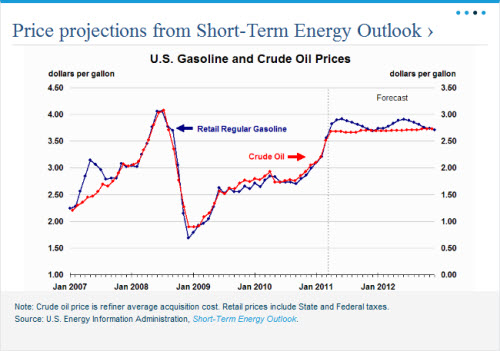
Nearly seventy percent of the price of a gallon of retail gasoline is the price of the crude oil it is refined from. Two graphs from the Energy Information Administration (EIA) make that point. The first shows the price of a gallon of gasoline (left axis) plotted against the price of a gallon of crude oil (right axis). The two move in virtual lock-step; if you know the crude oil price per gallon, add $1.00 and you’ll know the price of gasoline within a few cents. (At $105 per 42-gallon barrel, the per-gallon price of crude is $2.50; add a buck, and you get a gasoline price around $3.50.)

OK, so where does the $1.00 go that’s not paying for the raw product?

Nationwide, the average of state and federal taxes embedded into the price of a gallon of gasoline is 43 cents. We usually think of taxes the other way around, as with sales taxes. If you look at it that way, the effective “sales tax” on gasoline is 13.6%.

But as the next graphic shows, tax burdens vary greatly by state. Californians pay as much as they do at the pump largely because of the difference in state taxes. On top of that, California and a few other jurisdictions levy their tax as a percentage of the sales price (exactly like a sales tax), so that the California state treasury benefits handsomely from a higher gasoline price. (That’s not true in most jurisdictions, where the state tax is a fixed rate per gallon. Also, the tax burden shown in the graphic includes 18.4 cents per gallon in Federal taxes which apply to us all.)


Chances are the next network news report you see concerning high gasoline prices will come from one of the high-tax states on this map.

That leaves about 53 cents per gallon of your retail price that go toward the “downstream” end of the business: refining and marketing. Whether or not that’s a fair price to pay for these services is probably a story for another diary (or another diarist!), but it would be fair to say that the financial returns in the downstream end of the energy business have not been consistently impressive.

$4.00 for a gallon seems expensive, relative to what we are accustomed to paying. But a fair economic analysis of the value of the product must include its utility. A gallon of gas can transport four or more people in relative comfort 20 or more miles, and they can go when and how they wish to go. What is the value of that?

From the perspective of a producer (the “upstream” of the business), it is difficult and expensive to replace a gallon of gasoline in inventory. The price should be high enough to discourage waste, and high enough to reflect the true replacement cost of the resource. Increasingly hostile government policies regarding domestic exploration only increase the cost and difficulty of replacing reserves. An administration which threatens higher taxes on exploration and development dampens drilling plans. Supply tightens, prices go up. The cycle continues.

One last point — even at $4.00, it is difficult to name a liquid product which is cheaper per unit volume than gasoline.

Exxon Profit Up 53 Percent, Best Quarter Since Third Quarter of 2008 When Gas Prices Hit Record High

The Rockefeller family built Standard Oil of New York, which later became Mobil, a predecessor to Exxon/Mobil.

January 31, 2011

Associated Press - Exxon Mobil earned $9.25 billion in the last three months of 2010, its most profitable quarter since the record third quarter of 2008.

The largest publicly traded oil company said Monday that net income grew 53 percent in the fourth quarter as it produced more oil to take advantage of higher prices.

On a per-share basis, net income was $1.85 per share. In the year-ago quarter, Exxon earned $6.05 billion, or $1.27 per share. Exxon set a record for quarterly net income by a publicly traded company of $14.83 billion in the July-September period in 2008.

Revenue increased 17 percent to $105 billion.

The results beat Wall Street expectations of $1.62 per share on revenue of $99.1 billion, according to FactSet.

Oil companies' profits surged in the fourth quarter as the world consumed more petroleum and oil prices rose 12 percent to an average of $85.14 per barrel. Higher prices made production operations more profitable. Increased demand boosted margins at refineries.

Exxon cranked up production by 19 percent. Its Exploration and production operations posted income of $1.3 billion in the U.S. and $6.2 billion internationally. Downstream operations, which include refineries, reported earnings of $1.2 billion after losing money a year ago. And Exxon's chemicals business reported profits of $1.1 billion.

Last week, Chevron Corp. said net income soared 72 percent to $5.3 billion for the quarter while ConocoPhillips reported a 54-percent jump. BP reports quarterly earnings on Tuesday and Royal Dutch Shell releases its report Thursday.

For the full year, Exxon Mobil Corp. said it earned $30.5 billion, or $6.22 per share, compared with $19.3 billion, or $3.98 per share, in 2009. Annual revenue increased 32 percent to $383 billion.

Shares added 75 cents, less than 1 percent, to $79.74 in premarket trading.

Oil Hits 26-month High to End 2010 Up 15 Percent

Reuters
January 1, 2011

Oil prices hit a 26-month high over $92 a barrel on Friday, closing the year up 15 percent on expectations that the economic recovery will drive demand growth next year and send prices into triple digits.

Strong growth from Asia, especially China, and a rebound in demand from recovering economies elsewhere fueled a four-month rally that knocked crude over the $70-$80 range it held for much of the year.

U.S. crude oil futures surged to a 2010 high on Friday, settling up $1.54 a barrel at $91.38 a barrel, after touching $92.06, the highest level since October 7, 2008. The settlement marked the largest end-year price since 2007.

London Brent gained $1.66 to settle at $94.75 a barrel, its highest end-December settlement since 2007 and up nearly 22 percent on the year. Global output jumped 2.2 million barrels per day (bpd), according to a Reuters poll, the biggest increase since 2004, and another healthy 1.5 million bpd gain is forecast for next year.

While many experts say oil could break $100 a barrel in the new year, they don't expect a surge to levels near $150 seen in 2008, when crude first broke into triple digits. The Organization of the Petroleum Exporting Countries would step in to cool off markets if they headed into territory that could endanger the global economic recovery, analysts said.
"At some point, I would expect OPEC to increase production, whether through an extra cargo here or there to cash in on high prices or whether by a more concerted effort to calm people down," said Tim Evans, analyst for Citi Futures Perspective.
Recent gains in the dollar could also help cap oil's momentum by increasing the cost of dollar-denominated currencies for holders of other currencies.

U.S. crude averaged $79.61 a barrel for the year, second only to 2008's record $99.75. Crude shot to a high of $147 a barrel in July of that year, before the global recession hit demand and sent prices below $33.

Cold weather in the United States and Europe and OPEC's decision to keep production levels steady earlier this month have added to bullish sentiment this month. Analysts are watching to see how much of the recent rally has been caused by seasonal weather demand and how much has been driven by more structural consumption growth.

Speculators betting the economic recovery will boost demand have poured into oil markets, with net long positions held by money managers in U.S. oil futures hitting fresh records in December.

U.S. crude rallied back from early losses on Friday in light holiday trade of about 275,000 contracts -- about half the level seen over the past 30 days -- bouncing off lows near $89 a barrel.
"We're seeing exaggerated price swings because of low volume of trade but there is technical support around $89 a barrel and the rally will continue to march into next year," said Gene McGillian, analyst for Tradition Energy in Stamford, Connecticut.

Chevron Profit Rises 36 Percent on High Oil Prices

The Associated Press
April 29, 2011

Chevron Corp. said Friday its first-quarter net income rose 36 percent, the latest strong earnings report from a major oil company.

Chevron earned higher prices for its oil around the globe. In the U.S., Chevron sold its oil for an average price of $89 per barrel in the last quarter, compared with $71 a year ago. Internationally, Chevron sold oil for an average price of $95 per barrel, compared with $70 a year earlier.

This was partially offset by lower prices in the U.S. for natural gas. International natural gas prices rose slightly.

These higher prices led to a $1.25 billion increase in profit from exploring for and producing oil and gas. Refining profits more than doubled, to $622 million.

In all, Chevron's net income rose to $6.21 billion, or $3.09 per share, from $4.55 billion, or $2.27 per share a year ago. The results topped Wall Street expectations and marked Chevron's best three months since it earned $7.9 billion in the third quarter of 2008.

Gasoline prices have topped $4 per gallon in nine states plus the District of Columbia. As oil company profits approach levels of three years ago, when gas prices last spiked in the United States, the industry is fighting a renewed push from President Barack Obama and Democrats to end its $4 billion a year in taxpayer subsidies.

On Thursday, Exxon Mobil reported net income of almost $11 billion, its best quarter making $14.83 billion in the July-September period of 2008. That's the record for a publicly traded company.

Also, Shell's profit rose 60 percent to about $9 billion in the first quarter. France's Total SA made about $5.8 billion, up 50 percent. ConocoPhillips' earnings rose 43 percent.

Chevron's revenue rose 25 percent to $60.34 billion in the quarter.

In early trading, Chevron shares rose 24 cents to $109.05.

Rockefeller-owned Exxon Made $11 Billion in First Quarter 2011

The Associated Press
pril 28, 2011

Exxon made almost $11 billion and practically apologized for it.

Sensing public outrage over gasoline prices that have topped $4 in some states, the company struck a defensive posture Thursday after posting some of its best quarterly financial results ever.

Exxon said it had no control over high oil prices. It said it's one of the biggest taxpayers in the United States. It cast federal subsidies as "legitimate tax provisions" that keep jobs at home, and cast itself as a victim of Washington scapegoating.

"They feel they have to demonize our industry," said Ken Cohen, Exxon's vice president for public affairs.

What's more, the company argued, it doesn't even make that much money selling gasoline.

Exxon's profit of $10.65 billion for the first quarter was its highest since it made $14.83 billion in the third quarter of 2008, a record for a publicly traded company. That was also a time of $4-plus gas.

The first-quarter results were also the best among the big oil companies, which have reported improved results this week.

As oil company profits approach levels of three years ago, when gas prices last spiked in the United States, the industry is fighting a renewed push from President Barack Obama and Democrats to end its $4 billion a year in taxpayer subsidies.

This week, the industry's lobbying group touted the 9.2 million jobs that depend on Big Oil and rolled out a study showing that oil and gas stocks are excellent investments for public pension plans.

Before it even came out with the quarterly results, Exxon pleaded its case on a company blog, saying it was not to blame for high gas prices.

Then Cohen took an unusual step and spoke to reporters after Exxon reported the big profits. He said Exxon pays more taxes than any other company in the Standard & Poor's 500 index — $59 billion in the United States over the past five years. After taxes, the company earned $41 billion from U.S. operations during that period.

Drivers and politicians may still need some convincing. Gas costs more than $4 a gallon in eight states and the District of Columbia. The national average is $3.89 and has risen for 37 straight days.

At a time when most people aren't getting raises, gas has risen 81 cents a gallon this year. High gas prices ate into the nation's overall economic growth in the first three months of this year. The economy grew at a 1.8 percent annual rate, slower than the 3.1 percent at the end of last year.

Cohen has a point that Exxon doesn't control the price of oil or gasoline. Oil is traded around the world on public exchanges, and experts point out that the world is consuming more oil now than it did before the recession, raising demand. When oil prices go up at the exchange, Exxon sells oil for more money to refiners and other buyers.

Gasoline is made from oil. So while gas prices can rise and fall based on other factors, like refining problems or natural disasters, they generally go up as oil prices rise on the New York Mercantile Exchange.

Exxon noted that only 6 percent of its profit came from refining and selling gas in the United States. Other parts of its business, like selling oil and natural gas overseas, accounted for much more.

Argus Research analyst Phil Weiss finds that argument reasonable. But oil companies will struggle to win over people as long as they're making billions of dollars every quarter, he said.

"They get these high profits and people get upset. That's what politicians respond to," Weiss said.

House Democratic leader Nancy Pelosi called for a vote on ending taxpayer subsidies to oil companies next week.

"There is no reason American taxpayers should subsidize Big Oil's profits," Pelosi said.

The tax provisions at issue include some rules put in place as long ago as 1913 and more recent ones designed to encourage companies to invest in the United States. For instance, a 2004 rule that gives oil and other companies a special deduction for their U.S. operations could save the oil industry $18.2 billion over 10 years. A rule that allows faster depreciation of the value of oil and gas wells could save independent companies — those that only explore and produce oil but don't refine it — about $11 billon over a decade.

Exxon officials said it would be unfair for Obama to end oil subsidies while keeping similar incentives for renewable energy. The Obama administration and clean energy advocates argue that profitable companies do not need special tax treatment while newer industries deserve breaks until they can establish themselves.

It's not likely, though, that Exxon would give up its subsidies if the government also removed them for solar, wind and other renewables.

"Getting into trade-offs is not really helpful," Exxon Vice President Bill Colton said.

Environmental groups say the industry needs no taxpayer help.

"Why does an industry that makes this much money need $4 billion in tax subsidies?" asked Bob Keefe, spokesman for the Natural Resources Defense Council. "Why can't we use that tax money to improve and expand other alternatives, increase vehicle efficiency, better public transportation that would reduce our dependence on oil?"

Exxon counters that the government shouldn't decide which energy companies succeed and which fail. Whichever fuel source "produces the biggest bang for the buck for the consumer" will be the one the market settles on, Cohen said.

The main reason the industry is doing well is that oil prices were up 20 percent from the same period last year. Exxon's profit was 69 percent higher than the $6.3 billion it earned a year earlier. Revenue increased 26 percent, to $114 billion.

The rise in oil prices allowed Exxon to make more money despite producing 3 percent less oil overseas, about 2 million barrels per day, partly because of storms in the Middle East. Exxon sold crude in international markets for about $101 a barrel, up 36 percent from a year ago. In the U.S., Exxon sold oil for about $93 per barrel, up 27 percent from a year ago.

Exxon's per-share earnings of $2.14 beat Wall Street estimates by 10 cents, but oil industry stocks fell anyway because investors fear that demand for gas, which has fallen over the past month compared with last year, will keep dropping in the United States.

Exxon Mobil Corp. shares lost 94 cents to $86.84 in afternoon trading.

The company has increasingly focused on producing natural gas, which it expects to replace coal as the second most important fuel source after petroleum within the next decade. Last year it acquired XTO Energy to become the largest U.S. natural gas producer.

Flashback: Baron David de Rothschild Sees a New World Order in 'Global Banking Governance'


Baron David de Rothschild, the head of the Rothschild bank. The Rothschilds have helped the British government since financing Wellington’s army to fight the French in 1815.

UAE National
July 11, 2008

Among the captains of industry, spin doctors and financial advisers accompanying British prime minister Gordon Brown on his fund-raising visit to the Gulf this week, one name was surprisingly absent. This may have had something to do with the fact that the tour kicked off in Saudi Arabia. But by the time the group reached Qatar, Baron David de Rothschild was there, too, and he was also in Dubai and Abu Dhabi.

Although his office denies that he was part of the official party, it is probably no coincidence that he happened to be in the same part of the world at the right time. That is how the Rothschilds have worked for centuries: quietly, without fuss, behind the scenes.
"We have had 250 years or so of family involvement in the finance business," says Baron Rothschild. "We provide advice on both sides of the balance sheet, and we do it globally."
The Rothschilds have been helping the British government -- and many others -- out of a financial hole ever since they financed Wellington’s army and thus victory against the French at Waterloo in 1815.

According to a long-standing legend, the Rothschild family owed the first millions of their fortune to Nathan Rothschild’s successful speculation about the effect of the outcome of the battle on the price of British bonds. By the 19th century, they ran a financial institution with the power and influence of a combined Merrill Lynch, JP Morgan, Morgan Stanley and perhaps even Goldman Sachs and the Bank of China today. In the 1820s, the Rothschilds supplied enough money to the Bank of England to avert a liquidity crisis.

There is not one institution that can save the system in the same way today; not even the U.S. Federal Reserve. However, even though the Rothschilds may have lost some of that power -- just as other financial institutions on that list have been emasculated in the last few months -- the Rothschild dynasty has lost none of its lustre or influence.

So it was no surprise to meet Baron Rothschild at the Dubai International Financial Centre. Rothschild’s opened in Dubai in 2006 with ambitious plans to build an advisory business to complement its European operations. What took so long? The answer, as many things connected with Rothschilds, has a lot to do with history. When Baron Rothschild began his career, he joined his father’s firm in Paris. In 1982 President Francois Mitterrand nationalised all the banks, leaving him without a bank. With just $1 million in capital, and five employees, he built up the business, before merging the French operations with the rest of the family’s business in the 1990s.

Gradually the firm has started expanding throughout the world, including the Gulf.
"There is no debate that Rothschild is a Jewish family, but we are proud to be in this region. However, it takes time to develop a global footprint," he says.
An urbane man in his mid-60s, he says there is no single reason why the Rothschilds have been able to keep their financial business together, but offers a couple of suggestions for their longevity.
"For a family business to survive, every generation needs a leader," he says. "Then somebody has to keep the peace. Building a global firm before globalisation meant a mindset of sharing risk and responsibility. If you look at the DNA of our family, that is perhaps an element that runs through our history. Finally, don’t be complacent about giving the family jobs."
He stresses that the Rothschild ascent has not been linear -- at times, as he did in Paris, they have had to rebuild. While he was restarting their business in France, his cousin Sir Evelyn was building a British franchise. When Sir Evelyn retired, the decision was taken to merge the businesses. They are now strong in Europe, Asia especially China, India, as well as Brazil. They also get involved in bankruptcy restructurings in the U.S., a franchise that will no doubt see a lot more activity in the months ahead.

Does he expect governments to play a larger role in financial markets in future?
"There is a huge difference in the Soviet-style mentality that occurred in Paris in 1982, and the extraordinary achievements that politicians, led by Gordon Brown and Nicolas Sarkozy, have made to save the global banking system from systemic collapse," he says. "They moved to protect the world from billions of unemployment. In five to 10 years those banking stakes will be sold -- and sold at a profit."
Baron Rothschild shares most people’s view that there is a New World Order. In his opinion, banks will deleverage and there will be a new form of global governance.
"But you have to be careful of caricatures: we don’t want to go from ultra liberalism to protectionism."
So how did the Rothschilds manage to emerge relatively unscathed from the financial meltdown?
"You could say that we may have more insights than others, or you may look at the structure of our business," he says. "As a family business, we want to limit risk. There is a natural pride in being a trusted adviser."
It is that role as trusted adviser to both governments and companies that Rothschilds is hoping to build on in the region.
"In today’s world we have a strong offering of debt and equity," he says. "They are two arms of the same body looking for money."
The firm has entrusted the growth of its financing advisory business in the Middle East to Paul Reynolds, a veteran of many complex corporate finance deals.
"Our principal business franchise is large and mid-size companies," says Mr Reynolds. "I have already been working in this region for two years and we offer a pretty unique proposition. We work in a purely advisory capacity. We don’t lend or underwrite, because that creates conflicts. We are sensitive to banking relationships. But we look to ensure financial flexibility for our clients."
He was unwilling to discuss specific deals or clients, but says that he offers them "trusted, impartial financing advice any time day or night." Baron Rothschilds tends to do more deals than their competitors, mainly because they are prepared to take on smaller mandates.
"It’s not transactions were are interested in, it’s relationships. We are looking for good businesses and good people," says Mr Reynolds. "Our ambition is for every company here to have a debt adviser."
Baron Rothschild is reluctant to comment on his nephew Nat Rothschild’s public outburst against George Osborne, the British shadow Chancellor of the Exchequer. Nat Rothschild castigated Mr Osborne for revealing certain confidences gleaned during a holiday in the summer in Corfu.

In what the British press are calling "Yachtgate," the tale involved Russia’s richest man, Oleg Deripaska, Lord Mandelson, a controversial British politician who has just returned to government, Mr Osborne and a Rothschild. Classic tabloid fodder, but one senses that Baron Rothschild frowns on such publicity.
"If you are an adviser, that imposes a certain style and culture," he says. "You should never forget that clients want to hear more about themselves than their bankers. It demands an element of being sober."
Even when not at work, Baron Rothschild’s tastes are sober. He lives between Paris and London, is a keen family man -- he has one son who is joining the business next September and three daughters -- an enthusiastic golfer, and enjoys the "odd concert." He is also involved in various charity activities, including funding research into brain disease and bone marrow disorders.

It is part of Rothschild lore that its founder sent his sons throughout Europe to set up their own interlinked offices. So where would Baron Rothschild send his children today?
"I would send one to Asia, one to Europe and one to the United States," he said. "And if I had more children, I would send one to the UAE."
Lord Rothschild fund joins World Gold Council to put £12.5m into BullionVault
Family Fortunes - 1/3rd of the Top 500 Firms are Family-controlled

Meyer Rothschild died on September 19, 1812. In his will he spelled out specific guidelines that were to be maintained by his descendants:

1) All important posts were to be held by only family members, and only male members were to be involved on the business end. The oldest son of the oldest son was to be the head of the family, unless otherwise agreed upon by the rest of the family, as was the case in 1812, when Nathan was appointed as the patriarch.

2) The family was to intermarry with their own first and second cousins, so their fortune could be kept in the family, and to maintain the appearance of a united financial empire. For example, his son James (Jacob) Meyer married the daughter of another son, Salomon Meyer. This rule became less important in later generations as they refocused family goals and married into other fortunes.

3) Rothschild ordered that there was never to be "any public inventory made by the courts, or otherwise, of my estate ... Also I forbid any legal action and any publication of the value of the inheritance."

Exxon Mobil Shatters U.S. Record for Annual Profit

The Associated Press
January 30, 2009

Exxon Mobil Corp. (the Rockefeller family has the primary ownership/control of Exxon) on Friday reported a profit of $45.2 billion for 2008, breaking its own record for a U.S. company, even as its fourth-quarter earnings fell 33 percent from a year ago. The previous record for annual profit was $40.6 billion, which the world's largest publicly traded oil company set in 2007.

The extraordinary full-year profit wasn't a surprise given crude's triple-digit price for much of 2008, peaking near an unheard of $150 a barrel in July. Since then, however, prices have fallen roughly 70 percent amid a deepening global economic crisis...

Rothschild Investment Banking Posts Record Results

Seeking Alpha
November 21, 2008

The inability of the current investment banking model to withstand the ongoing liquidity crisis has forced many investment bankers out of business or those few that have survived to get by on reduced or no bonuses this year. However, as lenders globally continue to write off and provision for a significant volume of soured loans, U.K.’s Rothschild group, one of the world’s leading investment banking organizations, has posted record results. The bank has been able to maintain its very strong performance again this year, despite the credit crunch, economic slowdown and the threat of a U.S. recession, with investment banking and corporate banking businesses both producing record revenues.

The bank, according to Timesonline - reported a 31%, 459 million euro, improvement in profits. In addition, record results from the organization’s advisory and private banking operations enabled the bank to pay record bonuses to its 2,700 people in June.

The bank’s chairman David de Rothschild, following unconventional investment banking strategies, has steered his organization clear of proprietary trading, prime broking and other activities that have devastated rivals as a result of an environment where asset prices keep falling while liabilities remain fixed. The bank however, still wrote off 96 million euro because of souring loans. At some point, considering the global financial system is galloping off a cliff - today’s difficulties in investment banking will prompt an overhaul of the system favoring those players that have shown themselves to be the most cautious during this cycle.

Alongside its pro-forma group-wide results, Rothschild also unveiled that it had entered into a co-operation agreement in the field of M&A and Equity Capital Markets advisory in the food and agriculture sectors on a global basis with Netherlands’ Rabobank, a premier global financial institution providing financing and other services to food and agri business clients around the world.

As part of the deal, notes Timesonline, Rabobank is buying a 7.5% stake in one of the key holding companies in the Rothschild empire, Rothschild Continuation Holdings, which owns the N M Rothschild business in the U.K.

Rabobank becomes the second biggest investor outside the Rothschild family after the trading group Jardine Matheson, which owns 20%. This is Rothschild’s second joint venture with a Dutch bank.

Rothschild advisory clients include Rio Tinto (RTP), which is fighting a hostile bid from BHP, Billiton (BHP), and British Energy in its deal with France’s power giant EDF, a deal that gives the French company a dominant role in the British nuclear industry.

Speculation Explains More About Oil Prices Than Anything Else

McClatchy Newspapers
May 13, 2011

Feel like you're being robbed every time you fill the gas tank? Not sure who to blame? Try Wall Street.

That's not the conventional explanation, but it's the one the facts point to. Usually analysts say today's high prices stem simply from "supply and demand." They mean demand for oil and gas is rising and supplies aren't keeping up, so people bid up their price. But global and U.S. supplies are plentiful and demand is stable, so that's not it.

Then the analysts say it's because the market's afraid Middle East turmoil will interrupt oil supplies, so nervous buyers are bidding up prices to ensure they lock in a contract for oil now, just in case it's scarce later. There's probably some truth to that, but after five months of turmoil, there's been no significant impact on Middle East oil supplies, even as prices have see-sawed, so that's not credible either.

Why are gasoline prices high?

View larger image

Here's what's credible: Some 70 percent of contracts for future oil delivery are now bought by financial speculators — largely big investment banks and hedge funds — who never take control of the oil. They just flip the contract for a quick profit.

Only about 30 percent of oil contracts are bought by a purchaser that actually intends to use the oil, such as an airline. That's according to the Commodity Futures Trading Commission, which regulates trade in those contracts.

"I'm convinced ... that speculators are actively manipulating (prices)," said Michael Greenberger, a University of Maryland law professor who in the 1990s headed the CFTC's trading division.

"It's harder and harder for any reasonable observer to dismiss the role of excessive speculation in this market," said Michael Masters, a professional Wall Street investor who knows how this game works.

He's testified before Congress repeatedly that speculators are pushing prices up well beyond what supply and demand would warrant.

They both point to a $15 weekly swing in oil prices in early May and $5 a barrel moves on oil prices in a single day — with no obvious change to supply or demand.

Exxon Mobil Chief Executive Rex Tillerson noted Thursday in testimony before the Senate Finance Committee that this year's oil prices don't make any economic sense, though that's not quite how he put it. He said that current fundamentals and production costs would dictate oil in the range of $60 to $70 a barrel. That's at least $43 cheaper than this year's highs of $113 a barrel reached on April 29 and May 2.

But Tillerson declined to opine about the role of speculators, saying only that the price of oil "will be wherever it will be."

Hundreds of billions of dollars are being made through this speculation — both in the regulated futures market and on the larger unregulated over-the-counter swaps market, where private bets about the movement of oil prices take place. It's producing lots of new billionaires on Wall Street and driving oil company profits through the roof.

And it's punishing everyone who drives.

"The sheer volume of new capital coming from hedge funds, financial traders and other long-term passive investors — interests that mostly buy oil futures to turn a quick profit — is creating artificial demand and driving up the price for consumers," said Sen. Maria Cantwell, D-Wash., in a statement accompanying a letter she and 16 other U.S. senators issued Thursday.
They, like Greenberger and Masters, urge the CFTC to impose rules limiting speculators' ability to do this.

Masters and Greenberger advocate a return to limits that prevailed for much of the past century. Those limits effectively reined in speculation to about 30 percent of the oil market.

"We need some speculation. We need enough to provide grease for the wheels of the hedgers, but not so much that they drive price formation," Masters said.

A McClatchy review of two decades of data compiled by the CFTC documents the boom in speculative trading amid rising prices. In the 1990s, the ratio of speculative trades to trades made by commercial users of oil was tilted heavily toward users of crude. But from 1991 forward, the big financial players such as Goldman Sachs and J.P. Morgan Chase won exemptions that freed them from limits on how much they could speculate in futures markets.

They became classified as commercial traders, as if they were an airline hedging price risks in jet fuel. The big banks needed to invest in futures contracts to hedge bets they made in the unregulated swaps market. And the government, in the tenth year of Reagan Republicanism, was happy to reduce regulations on markets.

Oil "swaps" increased from $13 billion in the 1990s to more than $313 billion in July 2008 at oil's peak price, Greenberger said .

In mid-2006, CFTC data began distinguishing Wall Street's trades from industrial users, calling the strictly financial ones "non-commercial." Suddenly, the record shows that speculative trades raced past commercial trades.

Prior to the 1990s, speculators made up about 30 percent of the futures market. In the latest reporting period, the ratio on May 3 stood at 68 percent speculators to 32 percent users of oil. Meanwhile, the volume of total reported trades has grown five-fold since 1995, underscoring the impact of speculation on futures markets.

"It tells me that there are more speculative positions than there has ever been in history, particularly in the energy sector, I don't mean only crude oil," said Bart Chilton, a CFTC commissioner who thinks excessive speculation is at least part of the cause of soaring oil prices. "In all of the energy sector, we've seen a 64 percent increase in speculative positions since the (oil price) high of 2008."

While those numbers are stark, the numbers on supply and demand make it clear that the high prices aren't coming from there. There is no shortage of oil stocks by historical standards. There's an estimated 3 million to 4 million barrels per day (bpd) of excess oil production capacity in the world today. That's much more than when supplies were tight in 2008.

U.S. oil production, too, continues to grow.

It rose from 4.95 million bpd in 2008 to 5.36 million bpd in 2009, followed by 5.5 million bpd last year — even with the BP disaster in the Gulf of Mexico. The Energy Information Administration forecasts U.S. production to hold at that level this year and rise again next year, to 5.54 million bpd.

U.S. crude oil stocks on April 29, the date oil peaked this year above $113 a barrel, stood at 1.768 billion barrels, according to the EIA. That's about 700,000 barrels more than in July 2008, when oil prices hit all-time highs.

And that's plenty to meet U.S. needs, because consumption isn't growing.

The U.S. consumed 20.68 million barrels per day in 2007. Then came the financial crisis, and consumption dipped to 19.5 million bpd in 2008. Last year the number was 19.5 million bpd. This year's projection is 19.28 million bpd.

So if supplies are plentiful and consumer demand isn't rising, why are prices?

Could it be that refineries aren't able to produce enough gasoline? No. Refiners are running their plants at below cruising speed, and they've got lots of room to produce more if consumers need it. The latest data from EIA on the rate at which refineries are utilized showed a rate of 79.8 percent in February. That's 20 percent below full-blown production, and it hasn't been that low since 1986. If demand for gasoline were soaring, these plants would be cranking at a higher rate.

The American Petroleum Institute, the oil industry lobby, disputes this last example, noting that gasoline production continues at near record levels despite the low refinery utilization rates.

"The amount they're squeezing out of the barrel (of oil) has gone up significantly," said John Felmy, the group's chief economist.

Asked if excessive speculation is to blame for high prices, Felmy said no. He said growing economies such as China and India are gobbling up oil and that global energy data shows the price is "pretty consistent with fundamentals," and that "it really tells the tale of a tight market."

That's not what the Paris-based International Energy Agency said Thursday. It forecast flat global oil demand this year. It dialed back its projection for growth in consumption to 1.3 million bpd, less than half last year's growth of 2.8 million bpd.

The report said,

"Our own estimates for global oil demand show a marked slowdown, with preliminary March data suggesting near zero annual growth for the first time since summer 2009."

All that leads a growing number of analysts to one conclusion: This year's high prices for oil and gasoline, and their plunges of late, are driven largely by financial speculators making trillions by trading in oil futures while ordinary consumers feel burned.

While the evidence of speculation is increasingly obvious, the facts haven't yet been acknowledged enough to force corrective regulatory action.

"The history of this is there is always something going on in an opaque fashion that you only find out about after an investigation has been launched," Greenberger noted.

President Barack Obama last month ordered the creation of an interagency task force led by Attorney General Eric Holder to determine if price gouging or market manipulation is occurring. But he stopped short of ordering a full-blown investigation with additional government resources.

"My view is that the Justice Department should be actively organizing and driving an investigation that will strain the resources of some of these agencies," said Greenberger, himself a former Justice official. "Just playing 'footsy' with this investigation is a tragic waste of resources."

Justice Department spokeswoman Alisa Finelli insisted that by bringing together state and federal authorities, the task force "enhances our ability to take a comprehensive approach in monitoring and sharing information about the oil and gas markets to determine whether or not there is evidence of illegal activity."

Meanwhile, 17 U.S. senators, led by Cantwell, say the CFTC should act now.

"American consumers are getting gouged at the pump while speculation on Wall Street runs rampant. Today the CFTC must ... crack down on excessive speculation and provide relief to American consumers," she said.

Food is 29% More This Year Thanks to Speculation

Daily Mail
May 26, 2011

The annual Memorial Day BBQ bash may be a meager affair this weekend. You may be lucky to get half at this weekend's Memorial Day cookout, which is set to cost 29 per cent more than last year, thanks to inflation [and Wall Street speculation on commodities].

Those thinking of hosting a BBQ -- even a modest one -- can expect to fork out an extra $45 on food to serve a dozen guests. The total cost comes to $199, or around 29 per cent more than last year... and that's before soda and alcohol, according to the latest data for metro New York.

Lettuce has sky-rocketed 28 percent since last year's traditional BBQ, while an ear of sweet corn is now 50 cents, up from 20 cents last year. Those who don't like tomatoes are in luck though: they're up a staggering 86 percent on last year.

Nationwide the story is the same.

Ground beef is up 12.1 percent on last year and sausages are up 6.2 percent, according to the U.S. Bureau of Labor Statistics. And don't even think about potato salad. The apple of the ground is up 13.4 percent. Ice cream is up 5.1 percent, beer up 2.4 percent and coffee has increased by 13.8 percent nationwide.

The ever increasing price of gasoline is being blamed for the hike in food prices. Over the past year the cost of gas has increased by 33.6 percent, along with similar diesel hikes nationwide.

Steady rise: The price of ground beef has risen in the past year spiking last month with a 13.6 per cent increase

Steady rise: The price of ground beef has risen in the past year, spiking last month with a 13.6 percent increase

Extra expense: The cost of sausages has also risen, spiking last month with a 8.6 per cent rise

Extra expense: The cost of sausages has also risen, spiking last month with a 8.6 percent rise

This is squeezing the food industry to the max and farmer and food markets are being forced to pass on their growing costs to consumers at the fastest pace in several years, according to analysts.

Growers are also abandoning their usual crops of grains and vegetables in favour of acres of corn for ethanol in gas blends. A record 43 percent of the U.S.' corn crop went into gas tanks in 2010, according to the U.S. Department of Agriculture.

Costing the earth: The price of potatoes has also increased over the last year with a high of 13.4 per cent in April

Costing the earth: The price of potatoes has also increased over the last year with a high of 13.4 percent in April

~~~

We may never know for sure the combination of circumstances that brought on energy crisis of 2008. But one factor was almost certainly the Commodity Futures Modernization Act of 2000, which allowed unprecedented levels of speculation in oil futures by investment banks and pension funds, bringing the familiar boom-bust cycle home to the gas pump. - Drill Now? Try Regulate Now., Wall Street Journal, April 7, 2010

To lower international food prices and protect our social interests, the Commodities Futures Trading Commission must use its authority to curb excessive speculation in commodities futures and re-establish strict position limits on speculators (which were successful until removed by the Commodity Futures Modernization Act of 2000). We must regulate and bring transparency to all trading. We can also removing damaging speculative influence on commodities prices by prohibiting participation in commodities markets by those who do not produce, manufacture, or take physical delivery of the commodities. We must create a solidarity economy that puts compassion and care for one another ahead of short-term profits, in the United States and around the world. - The world food crisis: what is behind it and what we can do, WorldHunger.org, October 23, 2008

The surge in world food prices can be attributed to the “financialisation” of commodities due to the Commodities Futures Modernization Act of 2000. The game changed for commodities the minute the legislation passed -- ten years ago. That doesn't explain the surge this year but it does explain the increased volatility of the last decade. -
Don't Blame Bernanke: Here's Who's REALLY To Blame For Surging Food Prices, Business Insider, October 12, 2010

Go to The Lamb Slain Home Page