This is the ultimate in covert surveillance, the best spy bug in the world. Simply insert the software as you would in an ordinary mobile phone and then the Mobile Phone is converted into an ultimate spy tool. You can now call the device using a telephone from anywhere you like and the device will automatically activate, allowing you to hear all conversations from the device with crystal clarity.
Using your cell phone's tracking device and microphone, the government can eavesdrop on your conversations even if your cell phone is turned off. The only way around it is to remove your phone's battery.
The FBI appears to have begun using a novel form of electronic surveillance in criminal investigations: remotely activating a mobile phone's microphone and using it to eavesdrop on nearby conversations.
The technique is called a "roving bug," and was approved by top U.S. Department of Justice officials for use against members of a New York organized crime family who were wary of conventional surveillance techniques such as tailing a suspect or wiretapping him.
Nextel cell phones owned by two alleged mobsters, John Ardito and his attorney Peter Peluso, were used by the FBI to listen in on nearby conversations. The FBI views Ardito as one of the most powerful men in the Genovese family, a major part of the national Mafia.
The surveillance technique came to light in an opinion published this week by U.S. District Judge Lewis Kaplan. He ruled that the "roving bug" was legal because federal wiretapping law is broad enough to permit eavesdropping even of conversations that take place near a suspect's cell phone.
Kaplan's opinion said that the eavesdropping technique "functioned whether the phone was powered on or off." Some handsets can't be fully powered down without removing the battery; for instance, some Nokia models will wake up when turned off if an alarm is set.
While the Genovese crime family prosecution appears to be the first time a remote-eavesdropping mechanism has been used in a criminal case, the technique has been discussed in security circles for years.
The U.S. Commerce Department's security office warns that "a cellular telephone can be turned into a microphone and transmitter for the purpose of listening to conversations in the vicinity of the phone."An article in the Financial Times last year said mobile providers can "remotely install a piece of software on to any handset, without the owner's knowledge, which will activate the microphone even when its owner is not making a call" ...
... A decade ago, our phones' memories could just about handle text messages and a contacts book. These days, the latest smartphones incorporate GPS, Wi-Fi connectivity and motion sensors. They automatically download your emails and appointments from your office computer, and come with the ability to track other individuals in your immediate vicinity. And there's a lot more to come. Among other things, you could be using the next generation of phones to keep tabs on your health, store cash and make small transactions -- something that's already happening in east Asia (see "Future Phones" below).
These changes could well be exploited in much the same way that email and the internet can be used to "phish" for personal information such as bank details. Indeed, some phone-related scams are already emerging, including one that uses reprogrammed cellphones to intercept passwords for other people's online bank accounts.
"Mobile phones are becoming a bigger part of our lives," says Andy Jones, head of information security research at British Telecommunications. "We trust and rely on them more. And as we rely on them more, the potential for fraud has got to increase."
So just how secure is the data we store on our phones? If we are starting to use them as combined diaries and wallets, what happens if we lose them or they are stolen? And what if we simply trade in our phones for recycling?
According to the UK government's Design and Technology Alliance Against Crime (DTAAC), 80 per cent of us carry information on our handsets that could be used to commit fraud -- and about 16 per cent of us keep our bank details on our phones. I thought my Nokia N96 would hold few surprises, though, since I had only been using it for a few weeks when I submitted it to DiskLabs. Yet their analysts proved me wrong ...
In February, Google launched Latitude, networking software for smartphones that shares your location with friends. It can be turned off, but campaign group Privacy International is concerned by Latitude's complex settings and says it is possible the program could broadcast your location to others without your knowledge.
"Latitude could be a gift to stalkers, prying employers, jealous partners and obsessive friends," the organisation warns.
A phone-based calendar could also leave you vulnerable. Police in the UK have already identified burglaries that were committed after the thief stole a phone and then targeted the individual's home because their calendar said they were away on holiday, says Joe McGeehan, head of Toshiba's research lab in Europe and leader of DTAAC's Design Out Crime project, which recently set UK designers the challenge of trying to make cellphones less attractive to people like hackers and identity thieves.
"It's largely opportunistic, but if you've got all your personal information on there, like bank details, social security details and credit card information, then you're really asking for someone to 'become' you, or rob you, or invade your corporate life," McGeehan says ...
Future Phones
By next year about 1 in 3 new smartphones will have accelerometers. Pressure sensors and gyroscopes will follow,and soon your handset may keep tabs on your health and pay your bills too.
For example, Nokia is experimenting with adding biosensors capable of monitoring heart and breathing rates, as well as glucose and oxygen levels in the blood.
"Your phone could act as a wellness diary, and start to integrate data with the primary health records kept by your doctor," says Marc Bailey, a researcher at the Nokia Research Centre in Cambridge, UK.
Meanwhile mobile commerce, or M-commerce, in which phones are used to transfer money or pay for shopping, is already expanding rapidly. Cellphone users in Japan can buy train or airline tickets with their handset, while people in Afghanistan, the Philippines and east Africa can use their handsets to transfer money to each other.
"M-commerce is coming, and the expectation is that it will become prevalent in the UK and other European countries within four years," says Joe McGeehan, head of Toshiba's research lab in Europe.
Though these developments should bring many benefits, security is expected to become a problem. "As soon as you put money on anything, criminals become more interested in it," says McGeehan.
To counter this, manufacturers are developing more secure ways of encrypting data on handsets. According to Nokia, users will be able to alter security settings depending on how much data they want available at any one time. Phones with built-in fingerprint scanners are already on the market, and Sharp has experimented with face recognition on handsets, though hackers have recently shown that face recognition is easily defeated with just a photograph.
Meanwhile, Apple is thought to be considering adding biometric security measures, such as a fingerprint scanner, to future iPhones. However effective these security features are, though, they will only work when turned on.
Phone Security Q & A
If I delete a message or photo on my phone will it disappear completely?
Data often remains on a phone's memory chip until it is overwritten. Phones also create extra copies that are spread around its memory. It is possible to overwrite files by copying new data onto the phone. Commercial software will "zero fill" a memory or SIM card to overwrite it.
Where do recycled handsets end up?
According to Andy Jones, a security specialist at British Telecommunications, the main markets for recycled phones are Nigeria and China, "both of which are regarded as areas posing a high threat to the security of information."
What if I smash up my SIM card?
Forensic analysts can often recreate SIM cards using the data that's stored on the handset. How much information they can retrieve depends on the phone model. It is also possible to stick a damaged SIM card back together and then extract its data.
Can my movements be tracked, even if I don't have GPS on my phone?
A technique called cell site analysis can be used to track someone to within 10 to 15 metres, using cellphone masts to triangulate their position. GPS can give more detailed information, such as your altitude or the speed you are travelling at.
Can my handset be used to spy on me?
If someone can get direct access to your handset, they can install software that lets them listen to conversations and monitor text messages without your knowledge. Without direct access, they can still monitor your phone usage remotely, but not eavesdrop on your conversations. It is also possible to send text messages that look like they come from someone else -- a technique called SMS spoofing. This makes it possible to upload messages to someone else's Twitter account, or send your boss rude messages using a colleague's number.
How do I improve my phone's security?
Switch on all security options such as handset PIN codes. Download software to wipe your phone before you throw it away or send it for recycling. Consider buying a handset with fingerprint recognition security. Alternatively, add software that can find your phone or even take control of it remotely should it be stolen, allowing you to encrypt all data stored on it, disable it entirely or even make it emit a loud alarm.
Is it legal for my employer or partner to send my cellphone for analysis?
If it is a company phone, or was a present from your partner, beware. Chances are that they can claim legal ownership and so can do what they want with it.
The millions of people who use their cellphones daily to play games, download applications and browse the Web may not realize that they have an unseen companion: advertisers that can track their interests, their habits and even their location.
Smartphones, like the iPhone and BlackBerry Curve, are the latest and potentially most extensive way for advertisers to aim ads at certain consumers... Advertisers will pay high rates for the ability to show, for example, ads for a nearby restaurant to someone leaving a Broadway show, especially when coupled with information about the gender, age, finances, and interests of the consumer.
Eswar Priyadarshan, the chief technology officer of Quattro Wireless, which places advertising for clients like Sony on mobile sites, says he typically has 20 pieces of information about a customer who has visited a site or played with an application in his network.
“The basic idea is, you go through all these channels, and you get as much data as possible,” he said.
The capability for collecting information has alarmed privacy advocates.
“It's potentially a portable, personal spy," said Jeff Chester, the executive director of the Center for Digital Democracy, who will appear before Federal Trade Commission staff members this month to brief them on privacy and mobile marketing.
He is particularly concerned about data breaches, advertisers' access to sensitive health or financial information, and a lack of transparency about how advertisers are collecting data.
"Users are going to be inclined to say, sure, what's harmful about a click, not realizing that they've consented to give up their information" ...
Raw Story - The age of the plain old credit score is gone, says a report at the Wall Street Journal, and it's been replaced by ever more intrusive efforts by banks and credit agencies to gauge exactly what you're worth, and what you can pay.
To that end,financial firms are now tracking their customers' bank deposits, rent payments or home values, and even utility bills to figure out who may soon become a financial risk,reports WSJ's Karen Blumenthal.
So, for example, if your employer pays you through direct deposits and those deposits stop, financial institutions can now have warning that your money situation is likely to tighten, and may deny you credit on that basis.
But the efforts don't end there. A new area of research, income estimation, "took off earlier this year," WSJ reports, and involves financial firms collecting information about mortgages, personal loans and credit history to determine how much an individual makes and how much credit they should be given.
In this new era of deep data-mining, even your utility bills and rent check aren't out of bounds.
An estimated 40 million consumers, including young people and people who prefer to pay in cash, have too little credit experience to generate a useful credit score. But they are likely to pay rent or utility bills, which could help credit bureaus better assess their credit-worthiness.
Experian, one of the three major credit bureaus, bought RentBureau—which collects rental-payment data from large property managers—and expects to integrate that information into credit records before the end of the year.
Credit bureaus say they also would like to offer data on cellphone payments,but have run into concerns over privacy issues, which may require legislation to untangle.
BUSINESSES TARGET CELL PHONES, SOCIAL NETWORKING SITES
The WSJ report comes as new concerns emerge over the extent to which businesses are digging into the lives of their customers in order to assess risk or market products.
Raw Story reported this week on SocialMiner, a new software application from Cisco Systems that allows businesses to monitor social networking sites such as Facebook and Twitter.The software has raised concerns over the prospect of employers spying on the personal lives of their employees.
"With more and more Web-based conversations taking place over these social platforms, it's now more critical than ever that businesses are aware of what their customers are saying about them and are able to respond to general inquiries or rectify customer service issues so as to enhance and protect brand reputation," Cisco stated in a press release.
Meanwhile, a federal class action lawsuit alleges that numerous media companies, including Fox News and CNN, received detailed personal information on millions of cellphone users from an advertising company that circumvented security measures on their phones. Courthouse News reports:
Delaware-based Ringleader "stamped" a "Unique Device Identifier" into customers' cell phones, compatible with iPhone, iPad, iTouch and PDAs and other devices, the complaint states.
Once entered into their phones, the class claims, say the code sent their private information to a database that Ringleader shared with AccuWeather, CNN, ESPN, FOX News, Go2 Media, Merriam-Webster, Travel Channel, and WhitePages, all of them named as defendants.
"Essentially, defendants hacked the mobile phones of millions of consumers ... by embedding a tracking code in each user's mobile device database to circumvent users' browser controls for managing web privacy and security," the complaint states.
The class claims the database collected information about "gender, age, race, number of children, education level, geographic location, and household income."
When they learned about the invasion of their privacy, some customers tried to delete the code, but it was programmed for "perpetual re-spawning, creating in effect: 'Zombie Databases,'" the complaint states.
A new security hole has opened up in Apple Inc.'s iPhone, iPad and iPod Touch devices, raising alarms about the susceptibility of some of the world's hottest tech gadgets to hacker attacks.
Flaws in the software running those devices came to light after a German security agency warned that criminals could use them to steal confidential data off the devices. Apple, the world's largest technology company by market value, said Thursday that it is working on a fix that will be distributed in an upcoming software upgrade.
With the security hole, an attacker can get malicious software onto a device by tricking its owner into clicking an infected PDF file. Germany's Federal Office for Information Security called the flaws "critical weaknesses" in Apple's iOS operating system.
Internet-connected mobile devices are still subject to fewer attacks than personal computer, but they could eventually prove a juicy target for hackers because they are warehouses of confidential banking, e-mail, calendar, contact and other data.
Software vulnerabilities are discovered all the time. What makes the latest discovery alarming is that the weaknesses are already being actively exploited — albeit in a consensual way.
The latest concerns were prompted by the emergence of a new version of a program to allow Apple devices to run any software and circumvent the restrictions that Apple notoriously retains over software distributed through its online store. There are security risks of doing so, but many people find it liberating to install their own software.
Although this program is something people would seek out, the weaknesses that its authors discovered could easily be used for malice, security experts say.
There is an irony in the controversy: The site distributing the program offers a fix for the problem, but to get the fix, a user has to first install the program in question. So a user must defy Apple's restrictions to get the protection until Apple comes up with a fix of its own.
Charlie Miller, a prominent hacker of Apple products, said it likely took months to develop the program to break Apple's restrictions, but a criminal might need only a day or two to modify it for nefarious purposes.
Apple Inc. spokeswoman Bethan Lloyd said Thursday the company is "aware of this reported issue and developing a fix." She would not say when the update will be available.
One reason for gadget owners to take heart: Attacks on smartphones and other Internet gadgets are still relatively rare. One reason is PC-based attacks are still highly lucrative. Still, vulnerabilities such as the ones Apple is confronting show that consumers should take care of securing their mobile devices as they would their home computer.
"These things are computers — they're just small, portable computers that happen to have a phone tacked onto them," said Marc Fossi, manager of research and development for Symantec Security Response. "You've got to treat them more like a computer than a phone. You have to be aware of what's going on with these devices."
Out of Financial Chaos, Futurist Predicts Cashless Society and Robocops New Monopoly Game is Cashless Using RFID-enabled Cell Phones, Customers Scan Products and Pay for Purchases Road warriors: Smartphones with built-in GPS GPS on smartphones is no longer an emerging trend. It's almost a must-have feature nowadays, and more and more handsets are offering it. With the embedded GPS receiver and a mapping service, you can get real-time position tracking, text- and voice-guided directions, and points of interest. However, taking advantage of GPS, and the navigation powers that come with it, sometimes come at a price. If you want features, such as voice-guided directions, you often have to subscribe to a location-based service (LBS), such as TeleNav or VZ Navigator, which require a subscription fee. However, Google and Nokia are shaking things up by offering the premium features for free on such devices as the Motorola Droid, Nexus One, and Nokia 5800 Navigation Edition. How this will affect the LBS business remains to be seen, but one thing's for sure: if you're forever getting lost or are constantly traveling, there's help out there for you.
MEChA clubs have infiltrated college and high school campuses from coast to coast since the late ‘60s and early ‘70s, promoting anti-white racism in favor of a “bronze continent,” while teaching Latino, Chicano or Hispanic students that assimilation into American culture, language and customs is tantamount to becoming white.
We’ve piled “Raza (Race) Studies” on top of this anti-American, anti-white agenda in our public schools, which promotes overthrow of the U.S. government and resentment against American citizens of European descent as oppressors of people of color.
In March, a group from Mesa formed the East Valley Education Action Committee (EVEAC). Only two weeks into their research, they discovered “a lot of information regarding the indoctrination of our school children through the taxpayer funded International Baccalaureate (IB) school program and the New Global Citizens (NGC) after school program.”
The EVEAC notes that the IB program promotes world citizenship; views state education standards as being subservient to the worldview of IB.
The International Baccalaureate Organization (IBO) endorses the U.N. Universal Declaration of Human Rights (UDHR), which, through that endorsement, promotes the United Nations along with actions and treaties of the United Nations, including treaties not ratified by the United States, including: Biodiversity Treaty, Treaty on the Rights of the Child, Agenda 21, Kyoto Treaty and the Treaty establishing the United Nations International Criminal Court.
According to the EVEAC, by endorsing the UDHR, IBO promotes the United Nations as being the highest court of appeals on human rights and undermines the foundation principles of the United States.
The IBO endorses the Earth Charter, also not ratified by the United States.
The Earth Charter is identified by the World Pantheist Association as a Pantheistic (worship of nature instead of God) document.Besides Pantheism, the Earth Charter advocates the redistribution of wealth between nations and within nations, same-sex marriage, spiritual education in Pantheism, military disarmament and creation of an international agency to make the Earth Charter binding on all nations.
The New Global Citizen after-school program, which has at least 12 chapters in the Phoenix Metro Area, seeks to create global leaders, change agents and Saul Alinsky styled “locally led solutions to impact change on a global scale.”
The EVEAC says the program promotes Marxism under the banner of “economic and social justice;” transformation of students via “brainwashing;” sustainable solutions for “environmental justice;” and creation of global entitlements.
Quoting from the New Global Citizen’s pitch to the Mesa Rotary Club, EVEAC wrote:
“Last Year, New Global Citizens supported 76 teams on high school campuses in over 20 states across the U.S.A. this means that through our program over 1,000 young people took action to raise $37,000 to send to grassroots organizations around the world, educate 100,000 community members about global challenges, and launch 35 advocacy initiatives to support 33 grassroots organizations in 25 countries that are on the front lines of rectifying issues related to global poverty.”
As the Arizona legislature boldly passed SB 1070 to make it a state crime to be in the country illegally, it also passed HB 2281, prohibiting public schools from including courses or classes, which promote overthrowing the U.S. government, resentment towards a race or class of people, are designed primarily for pupils of a particular ethnic race, and advocate ethnic solidarity instead of the treatment of pupils as individuals.
The law requires districts to be in compliance within 60 days of receiving a notice of violation and allows the Arizona Department of Education (ADE) to withhold up to 10 percent of the monthly apportionment of the district’s state aide and requires the ADE to adjust the apportionment accordingly.
It allows the Superintendent of Public Instruction to withhold monies from the date of determination of noncompliance until ADE determines the school district is in compliance. The bill also contains a declaration of policy stating public schools should teach pupils to value each other as individuals and not foster hate toward other races and classes of people.
HB 2281 was passed with a delayed effective date of Dec. 31, 2010.
Section 4 of the 14th Amendment states:
“The validity of the public debt of the United States, authorized by law, including debts incurred for payment of pensions and bounties for services in suppressing insurrection or rebellion, shall not be questioned. But neither the United States nor any State shall assume or pay any debt or obligation incurred in aid of insurrection or rebellion against the United States, or any claim for the loss or emancipation of any slave; but all such debts, obligations and claims shall be held illegal and void.”
However, American taxpayers have been funding their own insurrection for over four decades through indoctrination disguised as education, utilizing social engineering to promote “social justice” and excluding American history and civics from the process.
The Truth About IB The International Baccalaureate (IB) program's primary purpose is to promote globalism and turn our children into global citizens. The Truth About IB's (TAIB) primary purpose is to celebrate what it means to be American and to preserve freedom for our children and grandchildren. TAIB represents the most comprehensive compilation of investigative research on the IB available on the Internet. The purpose of this site is to provide factual information and resources to parents and taxpayers who have unanswered questions about IB. Exposing IBO's Financials
Jesus saith unto him, "I am the way, the truth, and the life: no man cometh unto the Father but by me." (John 14:6)
There is none other name under heaven given among men, whereby we must be saved. (Acts 4:12)
And it shall come to pass, that whosoever shall call on the name of the Lord shall be saved. (Acts 2:21)
The Lord is not slack concerning His promise, as some men count slackness; but is longsuffering to us-ward, not willing that any should perish, but that all should come to repentance. (2 Peter 3:9)
While skeptics mockingly point out that the “end of the world” has been prophesized over and over again for centuries with nothing happening—the latest being Y2K, they say, and another likely bust coming up when the calendar hits 2012—it’s obvious that mankind faces an increasingly unsustainable future.
The post-World War II Nuremburg trials established that no one is innocent because they were simply following orders, a ruling that should apply to victims as well as perpetrators.
The world’s economic, technological, agricultural, and political systems are breaking down. While the causes are debated, it’s certain that the human assault on the natural world has wiped out vast numbers of species and polluted the land, the air, and the oceans. After the past 100 years of history, with two world wars and low-grade but vicious warfare going on almost continuously somewhere in the world since World War II ended, it seems impossible for human beings to live together in a state of harmony either among ourselves or with the planet we call home.
Are we at “the end of the age?”
In social life, the overriding characteristic of our era is the increasing division in the world between haves and have-nots, masters and slaves, controllers and controlled, rich and poor.The power of the wealthiest class of people has never been so great.The weapons of mass destruction they—and the armed forces who work for them—monopolize have the force to destroy the earth many times over.
Teachings of peace, tolerance, charity, which have always received lip service, lack efficacy. Such teachings increasingly count for nothing. Organized religion, done in by its own transgressions and lack of transformative potency, rarely even attempts to make a stand for justice or persuade nations to forego war.
The people at the very top of the heap have been those Western financial magnates, especially from the Anglo-American-Zionist empire and the European Union, who control banking, industry, investment, and credit.The world is run by an international financial elite and their subordinates in government, corporations, academia, the military, and the media.This elite have plunged billions of people and the nations they inhabit into astronomical levels of debt. They are the controllers who live off the fat of the land, skimming the cream of science and industry through usury on money they create out of thin air through financial monopolies granted or at least tolerated by the politicians whose strings they pull. No longer leaders of the popular will, the political classes of all Western nations, most particularly the United States, are servants of private financial and corporate interests.
The controllers realize how tenuous stability has become. So they seem to have embarked on a worldwide consolidation of power, using every tool available from the fields of electronic surveillance and social engineering to enhance their dominance. Nations not entirely under their control, such as Russia and China, are tagged as adversaries and surrounded with military bases. The controllers are suspected of having vowed among themselves that the existing world population of almost seven billion human beings cannot be allowed to continue.A large portion of the human herd must be culled, an action that now appears to be underway with the world’s resources increasingly passing into the hands of centralized financial interests.
But this will not necessarily fend off the even larger disaster that threatens mankind. For the controllers themselves also inhabit the earth. No man is an island. What threatens the least of God’s creatures threatens them as well.
The perspective of the controllers is therefore incomplete. What it leaves out are human freedom, aspiration, and spirituality. It also leaves out nature and nature’s laws. Further, it leaves out God, whatever we mean by that word, still knowing that there is “something” or “someone” who is the ultimate creative force.Perhaps these most materialistic elements of humanity are not quite as sharp as they think they are in trying to erect a fortress against the universe in order to save themselves.
For instance, they have not yet found a way to negate the law of cause and effect: “As ye sow, so shall ye reap.” An example is the BP oil catastrophe in the Gulf of Mexico caused by negligence in addressing pre-existent problems in a manner reminiscent of the space shuttle Challenger disaster of 1986. Both events exposed the pride of man as mere dust. Disasters may also be lying in wait due to genetically-modified seeds laced with pesticides where crop failures or the appearance of super-resistant insects could lead to mass starvation.
The controllers desire to rule from their glitzy world capitals of glass and steel while maintaining “safe” suburban, rural, or island palaces and retreats. Many, though not all, are the physical or spiritual descendents of those who rejected God by rejecting Jesus Christ 2,000 years ago, though according to some traditions their genealogy may be much older.Though the Christian churches offer many confusing and contradictory interpretations, it was Jesus Christ who prophesized the end of the age and sought to prepare mankind for it. Christianity is first and foremost an eschatological religion, especially as it hearkens back to such Old Testament prophets as Isaiah.
But in recognizing that the size of the human population is an overriding issue, shouldn’t we ask why are so many people alive on earth at this time? Where have they come from? Is it simply a result of improved sanitation, more productive farming methods, or the reduction in infant mortality? Or is there a hidden cause? The planet today resembles a train station at rush hour. Perhaps for the sake of discussion we should look at it from a somewhat mystical perspective. Should we consider, for instance, that the huge increase in the world’s population has taken place because all the human souls from the last several thousand years of history have been allowed to incarnate in order to give them one final chance to develop spiritually and move on to higher planes of being?
It could also be that a side-effect of the large earth population has been the emergence of the critical mass of information that has led in turn to exponential growth in science, technology, and economic productivity, the latest phase being the cybernetic revolution. Has man, in his vanity, attributed this apparent progress to his own stellar qualities, while failing to guard against the temptations deriving therefrom and their potential for binding him to the material plane? Perhaps man has surrendered his soul through a Faustian bargain based ultimately on the illusion which science promotes of someday attaining physical, as opposed to spiritual, immortality.In his delusion, man has viewed the earth as his true home rather than a place to reside temporarily for learning, experience, and eventual transcendence. The great parable of modern man may have been Goethe’s Faust, published in 1808 and prefiguring the spiritual crisis of the modern age.
We should note well the fact that due to social and political upheaval, combined with modern methods of communication, every person alive has been exposed to teachings of spiritual evolution, not just from Christianity, but from other religions such as Islam, Buddhism, Hinduism, and Taoism, as well as spiritual teachings such as yoga that cross religious lines. All have taught that our true home is in the spiritual realms, not in the rounds of earthly life and death. (Judaism is excluded from this list, as there are so many different Jewish sects, including so-called “secular Judaism,” that it is difficult to isolate a specific teaching on spiritual development.)
Why else have we seen in the past century so many enlightened teachings coming from all parts of the world, existing side-by-side with organized political, financial, and military horror? Doesn’t it seem that each and every soul on the planet is being tested? As indicated above, perhaps each of us is being given one last opportunity to attain enlightenment before the curtain comes down and the theater is closed for the season. This may be one way to look at the concept of the “end times.”
So what are we waiting for? Shouldn’t we be coming together to work in every way possible for the furtherance of truth and the enhancement of being? Shouldn’t we be creating centers of light to prepare ourselves and each other whatever lies ahead? Indeed, some are. But are we doing enough?
Time appears to be running out, with dire changes having already begun.Who knows, maybe there is only a year or two remaining of relative freedom of movement before the controllers reveal their deep affinity with the dark side by setting up what seems to be their planned world dictatorship, world government, and world currency.They have learned how to manufacture crises and disasters, such as 9/11, as a means of seizing more power.The signs that they are springing the trap will be the increased bureaucratization of all aspects of life, wartime measures like rationing and transportation checkpoints, centralization of financial institutions, control of populations through un- and under-employment, elimination of freedom of speech on the internet, and continued growth of computerized systems containing personal identifying information.As has happened before, the majority of people will likely be so sick of the rising tide of chaos, which the controllers have helped engineer, that they will willingly trade their autonomy for the shackles of totalitarian order.
To accomplish their ends, won’t the controllers also try to stamp out the last vestiges of spirituality on earth? They have already attacked many spiritual teachers and movements since the epochal change of consciousness that emerged in the 1960s. The rebellious flower children were seduced by dangerous drugs developed and distributed by covert operatives. Other examples were the engineered reaction within the Catholic Church against Vatican II and the liberation theology movement, as well as the takeover of Protestant Christianity by Zionists among the Evangelicals. A friend points out that militant Zionists also took over and subverted the Reform movement within Judaism. And it has been the Western intelligence agencies, going back over a century, who helped create radical Islam in order to declare the Middle East a base of “terrorism” so that war against the Islamic world could be rationalized and their oil resources seized.
The controllers engineered these and other reactions because the only way they can rule is to eliminate the naturally-occurring hope of free individuals for a higher level of consciousness and a more humane world.Other methods include mind control through TV programming and the continued dumbing-down of the population through an educational system now based entirely on learning by rote and government-mandated standardized tests. As 1984 and Brave New World showed to previous generations and the cynical manipulation of political reporting by Murdoch-owned Fox News indicates today, the masses are easy to control. Fox News is doing it by co-opting the Tea Party movement and goading it into a phony rebellion that ignores the real issues of elite control. All these elements hide the fact that it is the controllers who are the real terrorists in the world today.
Now embedded microchips, along with automated administration of pharmaceuticals to individuals by nanotechnology, appear to be on the way. The first step toward the microchip in the U.S. could be the national ID card as proposed by U.S. Senator Charles Schumer (D-NY) in connection with immigration reform. According to published reports, the card Schumer proposes would contain a person’s social security number, along with biometric data such as retinal scans and fingerprints. Such a card could easily be expanded to include credit and criminal history, DNA sequences, and medical history, all linked to a central database.
As cited in Politico, Sen. Schumer has stated his belief that “Hashem”—Hebrew for “the Name”—has appointed him the guardian of the state of Israel within the U.S. Senate. He has also spoken of himself as a potential presidential candidate. As events move forward, particularly with politicians like Schumer on the rise, many seemingly innocent people will be faced with difficult decisions of whether, and how far, to “get along by going along.”
But whoever accepts the chip, it is said, will wear the “mark of the beast”—by choice, because the conscience within will have cried out against it. The post-World War II Nuremburg trials established that no one is innocent because they were simply following orders, a ruling that should apply to victims as well as perpetrators. Of course “the chip” can take many forms, making self-deception and rationalization easy.
Yet God is not mocked.Every human being on the planet has a God-given conscience which allows us to distinguish between right and wrong—if we listen to our conscience. Some say we have an individual guardian angel who is the guide to our conscience. How many of us seek the counsel of this guide?
And is the time also at hand that the “earth changes” which have been prophesied will manifest on an increasingly vast scale? How will the planet cleanse itself? It has been prophesied, for instance, by Edgar Cayce and others that as part of this cleansing, New York and Connecticut will one day be under water. Such predictions seem less preposterous today than 60 years ago, now that scientists are discussing the increased potential for extreme climatic events through alterations in the earth’s magnetic field or in connection with earth temperature changes.
Without a doubt, the time must also come when the United States will no longer exist in anything resembling its present form.How can a nation as heedless, violent, prurient, complacent, and materialistic as this one possibly continue on its present course when the earth is purged of falsehood? How can objective justice tolerate a nation that sadistically tortures prisoners of war and routinely kills civilians with unmanned drone strikes halfway around the world?
G.I. Gurdjieff was a spiritual master from the Caucasus who studied in the most remote parts of Asia and spent his mature years teaching pupils in France. In the 1920s he visited the U.S., spending most of his time in New York. He reportedly said, “America will rot before it ripens.” The causes, he intimated, would be America’s obsession with “dollar business,” its diet of processed foods, and its dissipated lifestyle.
Gurdjieff was right. Regarding “dollar business,” today’s “Big Six”—J.P. Morgan Chase, Citigroup, Bank of America, Wells Fargo, Goldman Sachs, and Morgan Stanley—are the most rotten and corrupt institutions on the globe.They have sold America down the river by creating and destroying gigantic investment bubbles, feasting on massive bailouts paid for by taxpayers, and spending the last two generations shipping workers’ jobs to low-paying foreign labor markets. Then they turn around and use America and its passive population as the world’s policeman to protect their investments.
Just as bad are international institutions like the International Monetary Fund, the Bank of International Settlements, and the European Central Bank, as well as national central banks like the Federal Reserve, the Bank of England, the Deutsche Bundesbank, etc. While Hitler allegedly killed millions, the world’s bankers make life or death decisions that affect billions. They do it through control of the money spigot, which gives them power over every business and industry in the world that utilizes any form of credit. And credit is as essential to most businesses as breathing is to a human being.
When the dust settles, will there still be communities of human survivors in America? That may depend on the Americans themselves and how successful they are at reclaiming their freedom. Whatever survivors there are may be spiritually-minded and will of necessity live close to nature. But the scale and appearance of any future civilization is an unknown. Europe’s future could be as tenuous. Maybe Russia, China, and selected locations in Latin America, Asia, or Africa will do better. We don’t yet know.
What we should know is that the time is up for humanity.We have had our chance to decide what we value, whether service to a false conception of a separate self or service to God and neighbor. Now we are likely to find out for certain what measure of truth we have imbibed and incorporated into our being during many lifetimes.
The testing has come, but it has been foreseen for a long time. The Master came two millennia ago and showed the way. Why do we think someone else is coming now to save us? We were given the tools and the time to learn how to use them. Now we have no more excuses.
Rather than promote war, conflict, and conquest, anyone with a genuine spiritual sense will do everything possible to encourage peace, justice, and harmony among peoples and nations.Nevertheless, the “end of the age” seems imminent. As the Shivapuri Baba said, as recorded in the book Long Pilgrimage by John Bennett (Dawn Horse Press, 1983), “We are at the end of a 6,000 year cycle.”
We should strive not to be confused or complacent. It is time now for individuals to make a decision on where they want to be for the challenges ahead, with whom they want to spend their time, and exactly how they intend to devote their energy and commitment. The best advice is to choose wisely and choose well but not to wait any longer.
Jesus said: “Ye know not the day or the hour.” So why do we wake up every morning still thinking we know what the day will bring? In fact we do not know. The processes we are looking at herein could take a day, a year, or a century. So what is to be done? Following are some suggestions:
Find a teacher or group that can guide you to spiritual enlightenment and where you can help others do the same.
Teach yourself to act considerately to all those around you, including people you consider “evil.”
Start viewing the natural world as alive and conscious, not an inert mass of dead matter.
Get out of debt, get off the grid, and learn to live with only what you really need of a material nature.
Learn to love work and do that work with reverence and gratitude.
Stop watching TV; instead watch your health and diet.
Develop your mental, emotional, and manual skills.
Be honest with yourself and others.
Refuse the “chip,” no matter what.
Never stop learning.
Grow food.
Laugh a lot.
Be at peace.
Be happy.
Richard C. Cook is a writer on public policy issues. His website is www.richardccook.com. Sources for this article include the teachings of Edgar Cayce, G.I. Gurdjieff, P.D. Ouspensky, Abdullah Dougan, Jon Peniel, Omna Last, and many others.
"Verily I say unto you, this generation shall not pass, till all these things be fulfilled." (Matthew 24:34)
"Verily I say unto you, that this generation shall not pass, till all these things be done." (Mark 13:30)
"Verily I say unto you, this generation shall not pass away, till all be fulfilled." (Luke 21:32)
Scientists currently tag animals to study their behavior and protect the endangered, but some futurists wonder whether all humans should be tagged too.
By Gene J. Koprowski, FOXNews.com May 14, 2010
Scientists tag animals to monitor their behavior and keep track of endangered species. Now some futurists are asking whether all of mankind should be tagged too.Looking for a loved one? Just Google his microchip.
The chips, called radio frequency identification (RFID) tags, emit a simple radio signal akin to a bar code, anywhere, anytime. Futurists say they can be easily implanted under the skin on a person’s arm.
Already, the government of Mexico has surgically implanted the chips, the size of a grain of rice, in the upper arms of staff at the attorney general’s office in Mexico City. The chips contain codes that, when read by scanners, allow access to a secure building, and prevent trespassing by drug lords.
In research published in the International Journal of Innovation and Sustainable Development, Taiwanese researchers postulate that the tags could help save lives in the aftermath of a major earthquake.
"Office workers would have their identity badges embedded in their RFID tags, while visitors would be given temporary RFID tags when they enter the lobby," they suggest. Similarly, identity tags for hospital staff and patients could embed RFID technology.
“Our world is becoming instrumented,” IBM’s chairman and CEO, Samuel J. Palmisano said at an industry conference last week. “Today, there are nearly a billion transistors per human, each one costing one ten-millionth of a cent. There are 30 billion radio RFID tags produced globally.”
Having one in every person could relieve anxiety for parents and help save lives, or work on a more mundane level by unlocking doors with the wave of a hand or starting a parked car -- that's how tech enthusiast Amal Graafstra (his hands are pictured above) uses his. But this secure, “instrumented” future is frightening for many civil liberties advocates. Even adding an RFID chip to a driver’s license or state ID card raises objections from concerned voices.
Tracking boxes and containers on a ship en route from Hong Kong is OK, civil libertarians say. So is monitoring cats and dogs with a chip surgically inserted under their skin. But they say tracking people is over-the-top -- even though the FDA has approved the devices as safe in humans and animals.
“We are concerned about the implantation of identity chips,” said Jay Stanley, senior policy analyst for the speech, privacy and technology program at the American Civil Liberties Union. He puts the problem plainly: “Many people find the idea creepy.”
“RFID tags make the perfect tracking device,” Stanley said. “The prospect of RFID chips carried by all in identity papers means that any individual’s presence at a given location can be detected or recorded simply through the installation of an invisible RFID reader.”
There are a number of entrepreneurial companies marketing radio tracking technologies, including Positive ID, Datakey and MicroChips.Companies started marketing the idea behind these innovative technologies a few years ago, as excellent devices for tracking everyone, all the time.
Following its first use in an emergency room in 2006, VeriChip touted the success of the subdermal chip.
"We are very proud of how the VeriMed Patient Identification performed during this emergency situation. This event illustrates the important role that the VeriChip can play in medical care," Kevin McLaughlin, President and CEO of VeriChip, said at the time.
“Because of their increasing sophistication and low cost, these sensors and devices give us, for the first time ever, real-time instrumentation of a wide range of the world's systems -- natural and man-made,” said IBM's Palmisano.
But are human's "systems" to be measured?
Grassroots groups are fretting loudly over civil liberties implications of the devices, threatening to thwart their development for mass-market, human tracking applications.
“If such readers proliferate, and there would be many incentives to install them, we would find ourselves in a surveillance society of 24/7 mass tracking,” said the ACLU's Stanley.
The controversy extends overseas, too. David Cameron, Britain's new prime minister, has promised to scrap a proposed national ID card system and biometrics for passports and the socialized health service, options that were touted by the Labour Party.
"We share a common commitment to civil liberties, and to getting rid -- immediately -- of Labour's ID card scheme," said Cameron according to ZDNet UK.
These controversies are impacting developers. One firm, Positive ID, has dropped the idea of tracking regular folks with its chip technology. On Wednesday, the company announced that it had filed a patent for a new medical device to monitor blood glucose levels in diabetics. The technology it initially developed to track the masses is now just a “legacy” system for the Del Ray Beach, Fla., firm.
“We are developing an in-vivo, glucose sensing microchip,” Allison Tomek, senior vice president of investor relations and corporate communications, told FoxNews.com. “In theory it will be able to detect glucose levels. We are testing the glucose sensor portion of the product. It will contain a sensor with an implantable RFID chip. Today’s patent filing was really about our technology to create a transformational electronic interface to measure chemical change in blood.”
Gone are the company’s previous ambitions.
“Our board of directors wants a new direction,” says Tomek. “Rather than focus on identification only, we think there is much more value in taking this to a diagnostic platform. That’s the future of the technology -- not the simple ID.”
The company even sold off some of its individual-style tracking technology to Stanley Black and Decker for $48 million, she said.
Thesemedical applications are not quite as controversialas the tracking technologies.The FDA in 2004 approved another chip developed by Positive ID’s predecessor company, VeriChip, which stores a code -- similar to the identifying UPC code on products sold in retail stores -- that releases patient-specific information when a scanner passes over the chip. Those codes, placed on chips and scanned at the physician’s office or the hospital, would disclose a patient’s medical history.
But like smart cards, these medical chips can still be read from a distance by predators. A receiving device can "speak” to the chip remotely, without any need for physical contact, and get whatever information is on it. And that’s causing concern too.
The bottom line is simple, according to the ACLU: “Security questions have not been addressed,” said Stanley. And until those questions are resolved, this technology may remain in the labs.
Yet another sci-fi milestone is upon us: microchips implanted under your skin and used to identify you. The VeriChip is the first radio-frequency identification (RFID) microchip that’s been approved by the Food and Drug Administration for use in humans. The chip is the size of a long grain of rice, and can be implanted pretty much anywhere in the body (most commonly along the tricep). Depending on how it’s used, the chip could do anything from telling doctors your medical background to buying you a round at the club.
Outside of human bodies, RFID is already used for a wide range of purposes. If you pay highway tolls electronically, that little box in your car has an RFID tag in it. Lots of folks implant their pets with RFID chips in case they get lost, as animal shelters increasingly scan pets for them. Wal-Mart tracks their shipments with RFID, which has apparently revolutionized supply chain management. Hell, there’s even one in your passport.
But why put one inside your body? As interesting as it might be to have your ID show up on an x-ray, most people would rather suffer a line at the DMV than a rice-injection. Sure, it might make for good conversation at a party. But is that worth the needle? What would it take to get one under your skin?
Emergency Situations
VeriChip Corp. markets their product to address what they call “a serious need for personal identification and information in emergency situations.” Over the past two years, the company has piloted their product with 200 Alzheimer’s patients in a Florida facility. Because of their condition, many patients are unable to effectively communicate if they are admitted to the hospital without caregivers present. The VeriChip contains a 16-digit ID number which links the recipient to a secure computer database where their medical information is stored. The chips are used to replace MedicAlert wristbands, which can be removed or damaged.
Most other proposed applications for in-body RFID are medical in nature: providing doctors immediately with a patient’s medical records, or identification if they are unconscious or unable to communicate. Still, these applications require that each hospital contain a computer database to connect an individual’s tag with their information. That’s probably a long way off.
Luckily, the hospital isn’t the only testing ground for RFID chips under the skin. A nightclub in Barcelona called Baja Beach has started offering chip implants to its customers, giving them access to VIP lounges and letting clubbers buy drinks by acting as a debit account. Who wants to carry a wallet or purse when the dress-code is board shorts and bikinis? Baja Beach contracted none other than VeriChip Corp. to fashion their subcutaneous membership cards. I guess last call counts as an “emergency situation.”
In the past, VeriChip Corp claimed their chips could not be counterfeited: if your ID is under the skin, it can’t be so easily stolen.Wrong. At a hacker conference in 2006, Annalee Newitz and Jonathan Westhues showed that they had successfully cloned an RFID chip implanted in Newitz. A home-built antenna let the hackers steal the unique ID contained on the chip, which apparently lacks any sort of security device.
If RFID chips aren’t exactly secure, most people won’t want their social security number contained on one.After all, if a doctor’s office can pull your medical records from the chip (and a hacker can, too) what’s stopping your insurance agency? Or identity theives? That limits the chips to using random numbers, corresponding to useful information on a separate and secure database. And until those databases are standardized and prevalent, having a chip in your body won’t speed up your doctor’s visit very much.
Counter-ID
As you might already imagine, in-body RFID chips have spawned a considerable backlash of protest. The group AntiChips calls the VeriChip “human branding,” especially in the case of the “volunteers” for the program with Alzheimer’s disease. They also claim the chips cause cancer (citing a number of animal studies), and that the FDA approval should be revoked (more info here).There are also a number of additional risks which the FDA already recognizes: tissue reactions, migration of the chip, even the chance that the chip could carry a current from MRI magnets and burn the patient.
And that’s just the beginning. The chips have been called the precursor to a perfect authoritarian state, letting Uncle Sam (or Illuminati, or whoever) track your each and every move. On the other end of the spectrum, some religious groups (well, okay, this one) have implicated the VeriChip in a plot involving the mark of the beast (666), part of a conspiracy theory to rival the most imaginative of left-wingers. Wait, this one too.
But if I can interject my own opinion, I’d say the whole business is a bit overhyped. Honestly, there aren’t really any good applications for in-body RFID. Sure, it could hypothetically improve health-care (if and when the patient is unconscious), but for that system to be effective, every hospital would need to have integrated the chips into their standard procedures. It won’t replace a photo ID in your wallet anytime soon. And unless you’re grinding some PYT* in Barcelona, you’ll probably pay for that Pabst with good old fashioned cash. Take (a) the lack of practical applications, plus (b) legitimate concerns over ID hacking and health risks, and poof! There goes the revolution.
... In the 21st century, fraud is as American as baseball, apple pie and Chevrolet Volts—fraud’s all we got left, Doc. Scare off the fraud with Obama’s “scrutiny,” and the entire pyramid scheme collapses in a heap of smoldering savings accounts.
That’s how an acquaintance of mine, a partner in a private equity firm, put it: “Whoever pops this fraud bubble is going to have to escape on the next flight out, faster than the Bin Laden Bunch fled Kentucky in their chartered jets after 9/11.”
And that’s why this SEC suit accusing Goldman Sachs of fraud is really just a negotiating bluff to give Obama’s people some leverage—or it’s supposed to be, anyway—according to the PE guy. He dismissed all the speculation that the fraud investigations would turn on other obvious villains like Deutsche, Merrill, Paulson & Co., the Rahm Emmanuel-linked Magnetar and so on.
“You don’t get it, Ames. Even Khuzami, the SEC guy in charge of the Goldman case, is a fraud; the fucker was Deutsche’s general counsel when they pulled the same CDO scam as Goldman. You have no idea how deep this goes.”
And it’s clear that a lot more people here are aware of how fundamentally rotten things are but they’re not willing to face the big fraudonomics bummer yet, preferring instead to stick with specific accusations.
My position on this was, “Good, throw the book at those crooks too, I don’t see what the problem is here.”
This was exactly what I argued a week ago, during a verbal slapfight with that acquaintance of mine. We were making a scene in a Midtown yuppie restaurant, arguing over just how much damage Wall Street had caused, and what to do about it.
His position was indefensible, and he knew it, so he switched tactics:
“OK Ames, which bankers would you throw the book at? Because you’re arguing that they’re all guilty. So which ones do you go after? Two of them? Three? Half of them?”
“Every last one of them. Lock ’em up in one of their private prisons.”
“Not gonna happen, Che.”
“Che? Me? Listen, Scarface, I’m about law and order. Don’t any of you PE degenerates believe in that anymore?”
“OK, here’s the deal, Che. I’m going to walk you through this nice and slow so that even an agave-sweetened hippie like you can understand this. Stick with me, this is gonna be a little complicated. Ready?” And so he began.
“Let’s say the government decides one day, ‘You know, we oughta listen to Che here, let’s throw the book at every firm and every executive that our people can make a case against. Because you know, gosh, it’s all about rule of law and blind justice, just like Che says.’ OK, so now this means indicting just about every serious player in finance, so they take down Goldman Sachs, they take down Citigroup, JP Morgan, BofA… and they also serve all the big funds who are at least as guilty, if not more.So they shut down Pimco, Blackrock, Citadel… maybe they indict Geithner and Summers, haul in some of Bush’s crooks… right?”
“Go on, I’m gonna order some hot, buttered popcorn for this. Don’t mind me.” I liked what I was hearing so far.
“OK, now guess what you’ve just done? You’ve just caused the markets to completely tank. Remember what happened after the Lehman collapse? Remember how popular that made every politician in Washington? Still wondering why they coughed up a trillion bucks? They were scared for their lives; that’s why they voted for that bailout. You’d have done the same goddamn thing. But if we go after everyone guilty of fraud and theft, the market crash this country would see would make 2008 look like Sesame Street. Open that can of worms labeled ‘Fraud’ and the whole fucking economy collapses. You may as well prosecute people for masturbating. No one will know where the fraud investigation stops and who will be charged next—everyone will try to cash out, and the markets will tank to zero. And guess what happens when the markets tank to zero? Every fucking American with a retirement plan, or an investment portfolio, or a 401k—every state pension plan in the country, every teacher’s pension fund, every fireman’s pension—every last one of them will be wiped out. That’s what the Lehman collapse taught us.”
“Us? It didn’t teach anything but that this country is run by maniacs.”
“Jesus H. Christ, you’re even more clueless than the idiots who managed the Lehman collapse. I mean, didn’t everyone get it how badly those idiots screwed up with Lehman? It was the biggest screw-up this hemisphere has ever seen. You had Secretary Paulson and Fed Chief Bernanke scratching their asses not knowing what to do, so then they go, ‘OK, we’re supposed to be a free market economy, and we’re supposed to be the Republicans—let’s try something different for a change since nothing else is working. Let’s go out on a limb and actually give this “free market” thing a whirl. Who knows? Maybe the “free market” really works the way we always say it does. Nothing else seems to work, let’s let the free market decide Lehman’s fate. Maybe corporate-socialism isn’t the answer.’ So they hung Lehman out in the free-market, and BAM! The. Shit. Hit. The. Fan. No shit, dudes—the free market is for suckers, didn’t your daddy teach you idiots that? Not only did Lehman collapse—everything collapsed; confidence in the entire system collapsed. And here’s what I’m trying to explain to simpletons like you: Our economy is just a confidence game. Don’t ask me how it got this way, don’t care.”
I tried saying something insulting to him, but he just talked right over me. He was on such a roll.
“I’m sure you have the answer, you and Ron Paul and all the other pot-smoking libertarian do-gooders have it all figured out. But what I’m saying is, no confidence means end of the confidence game. That’s what Lehman showed. Every single player in finance suddenly had to face the fundamental problem—this whole fucking economy is built on fraud and lies and garbage. So when Lehman collapsed, every single player panicked, going, ‘If Lehman was nothing but a Ponzi scheme—and I know what I’m running is a Ponzi scheme—holy shit, that means everyone else is running a Ponzi scheme too! Run for the exits!’ No one trusted anyone else, everyone pulled out, and the entire global economy collapsed just like that. And that meant your parents, my parents, every teacher, every fireman, every person in the country going into retirement, every price on every asset—wiped out.
“And here’s what I’m trying to get you to understand: In the grown-up world, when an entire country’s savings accounts are wiped out because of some do-gooder and his law books and his Thomas Jefferson ‘What about free and fair markets?’ crap, that is a big problem—people don’t give a fuck about Jefferson and ‘free and fair markets,’ they just want their savings to be worth something. And people are right: Jefferson was an imbecile. He should have been a folk singer, not a Founding fucking Father. But that’s another issue that’s over your head—the point is, the guy who destroys this economy because it’s ‘the right thing to do’ will have to flee for his life, and whatever president or political party was in power when that decision was made will be out of power for the next 200 years. That’s why Washington panicked and passed ‘the bailout,’ they didn’t want to be the fools whom all the Ponzi victims blame for tanking the Ponzi scheme, so they broke the glass and pumped up a newer, bigger Ponzi scheme. It was an expensive 14 trillion dollar lesson in, ‘Stay the fuck away from free-market experiments, assholes!’ How naive are you people to actually believe that ‘free market’ crap? The problem is when people in power are stupid enough to listen to guys like you: all the do-gooder libertarians and the do-gooder free-market Republicans who forgot that they’re supposed to lie. Hello!”
“Libertarian, me? Since when was I ever a libertarian?”
“That’s my point: Fools like you don’t even know who you are anymore. They forgot that they’re supposed to lie about all that libertarian free-market shit, keep it far the fuck out of policy. But instead of just lying about free-markets while secretly propping up Lehman, the idiots actually tried pulling off a ‘free-market’ miracle, and we had to pay $14 trillion just to find out what I could have told them for no fee at all, which is: ‘Hey, assholes, you’re supposed to be hypocrites, OK? You’re supposed to be two-faced free-market liars, not libertarian Quakers! You’re not supposed to believe in anything—your job is to get up in front of the public and lie about free markets and the rest. Period.’
“That’s it, how fucking hard is it? Look, watch my face: Say one thing out of one side... and do the other out of the other side. Got that? Let everyone else whine and cry about, ‘Ooh, that’s not fair, ooh, that’s a bailout, that’s socialism, that’s corruption.’ That’s what losers do—they whine. You, for example, Che—you whine all the time, and look at you... Can you pay the bill for this meal? Is there a libertarian on earth who can afford to buy a decent meal in Manhattan? And now, look at me: I’m a hypocrite. Hell yes I am! I lie every day of my life, I lie to myself in my sleep. Hell, I’m lying to you right now, in fact I don’t even know what the fuck I’m saying anymore because I’m so used to lying. And yet—who’s the guy with the black card? Who’s the one who’s going to pick up the check tonight? Guys with power, guys like me, we lie. You got that? ‘Lie’ as in ‘My Lai’ the massacre—as in, ‘My Lai you long time, me so free-markety.’ You distract the dumbshits with free-market B.S. because hey, for whatever reason, that’s what the public likes to hear, it doesn’t really matter what lie you feed them so long as it’s the lie that puts them in a trance. And then behind the scenes, you do the very opposite: You fix the game, you cover up this problem here with those funds there, you move shit around, you skim budgets and you subsidize the system, you cover up the bad shit and once in a while throw a has-been to the wolves to keep the public entertained—that’s the way the system works, and anyone who’s an adult understands that. And everyone who doesn’t understand that can go form an online libertarian chat group and complain with all their little libertarian friends about free markets and Jekyll Island and ‘Wahhh! It’s not not fair, waahhhh!’”
“What’s with the libertarian accusation?”
“It’s just that you all sound the same to me. Libertarians, hippies—is there really a difference? You all whine alike: ‘It’s not fair, man! Ooh! You can’t do that, it’s fraud, it’s corruption, ooh no!’ Or: ‘It’s the income inequality, man; Goldman Sachs controls us all man; it’s socialism for the rich; it’s all too scary for my retarded 5-year-old libertarian brain!’ Seriously, anytime I meet libertarians like you—”
“Listen—I’m not a fucking libertarian, OK? I want free handouts. How clear do I have to make this? Me—handouts. Me—Big Government. I want to collectivize your productive cash, because I am a resentful parasite. Are you capable of processing a single word of what I’m saying to you, Spaz?”
“Uh-huh, sure, whatever. Here’s the thing: I think it’s great that you and your friends memorized Road to Serfdom in between Star Trek episodes—no really, I’m happy for you. Yeah, we’re all so proud. But here’s the thing: We grown-ups are really, really busy now trying to sort out the free-market mess you made with that Lehman move of yours. Yeah, so why don’t you run along to your libertarian chat rooms and have your little debates about Jekyll Island and the gold standard, because it really means a lot to us. And report back to me as soon as you have it all figured out, m’kay? Just get the fuck out of my face and leave the adults alone.”
It got a lot more vicious and personal than this, but when our verbal slap-fight ended—and he paid the bill—I thought about what he said, and it made a lot more sense. Fraud has become so endemic in this country that it’s woven its way into America’s DNA, forming a symbiotic relationship that can’t be undone without killing off the host. If they push it just a little too hard, the entire American economy could crash, asset values could tank, and that means tens of millions of extremely pissed off retirees and Baby Boomers. As the Wall Streeter put it: “Whoever is responsible for bursting this latest bubble by exposing all the fraud—and tanking all the markets—will not only be out of power for at least a generation, but they’ll all have to get radical reconstructive surgery on their faces and seek political asylum somewhere remote. No one wants to be that guy, and that’s why it’s not going to happen.”
That may be true, but all bubbles to eventually burst, all Ponzi schemes do collapse. The only question is when. For those of us not on the verge of retiring, the sooner we have this day of reckoning and get it over with, the better.
Not sure how pervasive fraud is in our society these days? Check out Mark Ames' quick and easy Fun Fraudonomics Facts here.
Much like the earth, the Sun has many different layers that define its structure. Unlike the earth, the Sun is completely gaseous; there is no solid surface on the Sun.
The Sun is a very active star. No matter when or where you look, the Sun is always doing something interesting. One of the most dramatic properties of the Sun's activity is the existence of a solar cycle, which is best seen in the pattern of sunspots. The number of sunspots on the Sun is not constant but varies significantly with a peak number showing up, approximately every 11 years. The Sun, thus, has a cycle of behavior which repeats every 11 years.
It is not known exactly what causes this repeatable behavior but processes in the deep interior of the Sun, which generate magnetic field, are thought to be responsible.
Over the last 30 years scientists have developed theories to explain this behavior and improved observations from telescopes in space are providing much needed information to help track down the answer to this particular solar conundrum.
The Earth is now entering a phase with unstoppable and dramatic global cooling, which will initiate a new Little Ice Age within the next decade. The cause of this cooling is the predicted, and now real, reduction in solar activity that we now can see. These conditions will persist during the next solar cycles. This will have a devastating effect on agriculture, lowering food production and increasing the risk of widespread famine. This will also increase the demand for fuel. [Global Cooling Is Now Imminent, Is Unstoppable and Will Be Severe!, Per Strandberg, March 18, 2008]
With the PDO now in its cool phase, solar activity the weakest in more than 100 years, and the prospect of a major climate-cooling volcanic eruption, actions to limit CO2 emissions should be shelved and preparations made for an extended period of global cooling that would pose far more danger to humankind than any real or imagined warming predicted by today’s climate models. The largest emitters of carbon dioxide are volcanic eruptions, forest and wild fires, and natural decomposition of plants and animals — this is a good thing, since there is a relatively stable and finite amount of both oxygen and carbon on this planet. If it weren’t for carbon dioxide, the earth could well be a frozen ball in space, and life, as we know it, would probably not be able to survive. Cold is far more threatening than the little extra warmth we experienced from the warm PDO during 1977 to 1998 — during that period crop yield decreased 30 percent and there was a 10 percent decrease in arable land. A cooling down to 'Dalton Minimum' temperatures or worse would lead to shortened growing seasons and large-scale crop failures. Food shortages would make worse the fact that more people die from cold than heat. The Triple Crown of Global Cooling:
Cooling North Pacific sea surface temperatures (Pacific Decadal Oscillation or PDO),
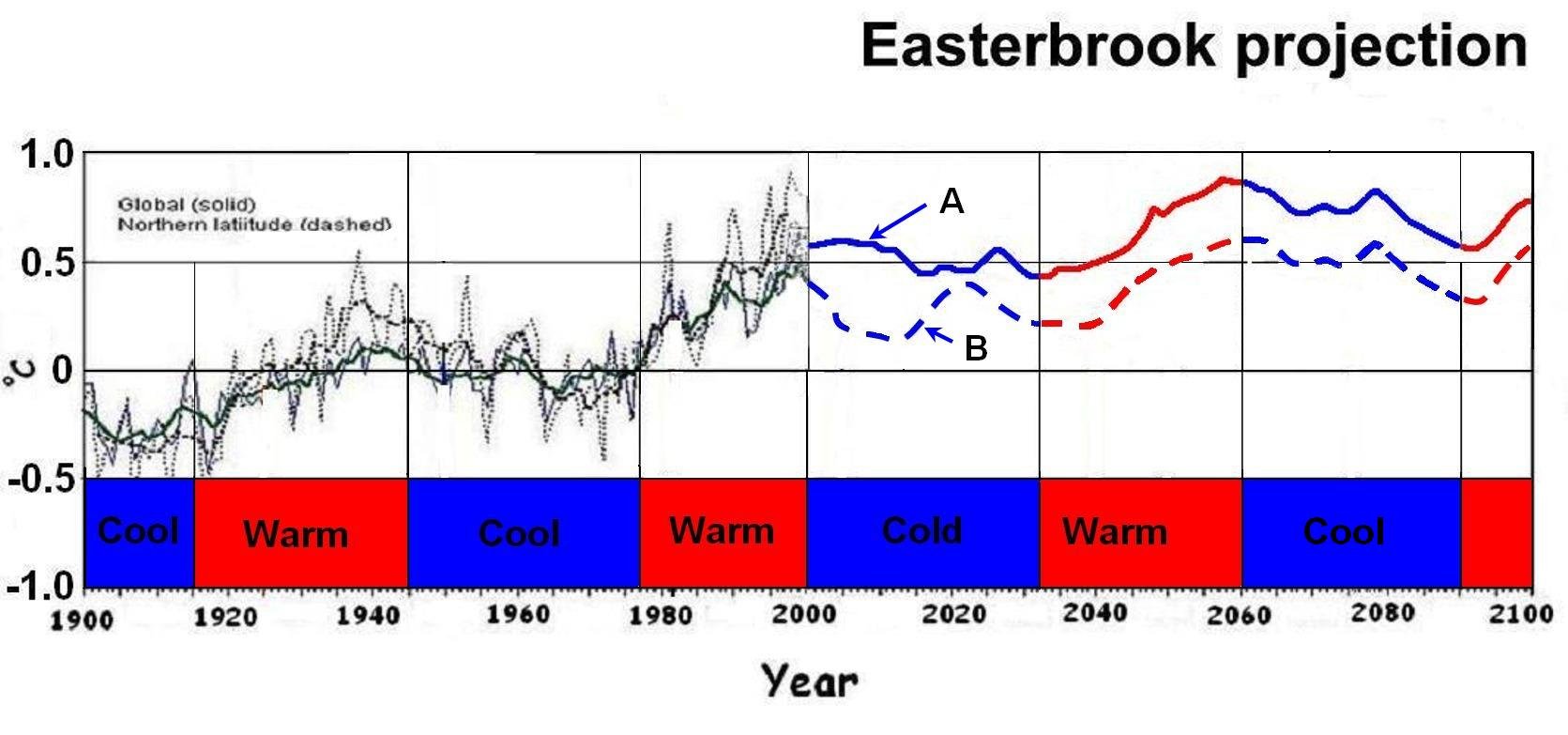
In a Geological Society of America abstract (see following story), Dr. Don Easterbrook, Professor of Geology at Western Washington University, presented data showing we were in a global warming cycle from 1977 to 1998, at which time we entered into a new global cooling period that should last for the next three decades.
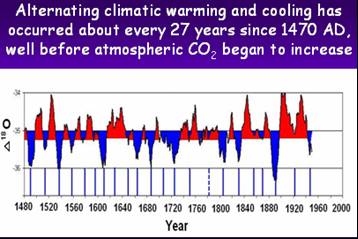
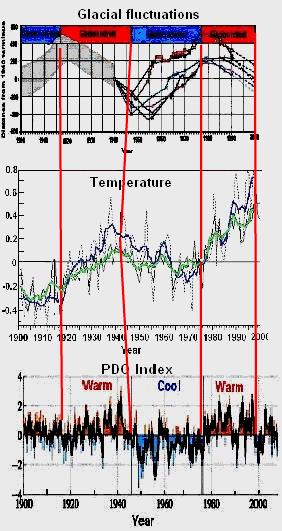
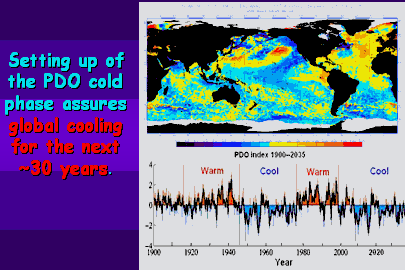
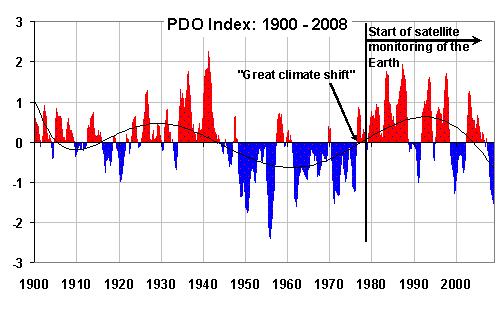
The Pacific Ocean has a warm temperature mode and a cool temperature mode, and in the past century it has switched back and forth between these two modes every 25-30 years (known as the Pacific Decadal Oscillation or PDO).The PDO typically lasts 25-30 years and assures North America of cool, wetter climates during its cool phases and warmer, drier climates during its warm phases. Back in 1977, the Pacific abruptly shifted from its cool mode (where it had been since about 1945) into its warm mode, and this initiated global warming from 1977 to 1998.
In 1998, the Pacific shifted back to its cool mode.In 2008, NASA satellite imagery confirmed that the Pacific Ocean had switched from the warm mode it had been in since 1977 to its cool mode, similar to that of the 1945-1977 global cooling period.
The establishment of the cool PDO, together with similar cooling of the North Atlantic Oscillation (NAO), virtually assures several decades of global cooling and the end of the past 30-year warm phase. It also means that the IPCC predictions of catastrophic global warming this century were highly inaccurate. Dr. Easterbrook also suggests that since the IPCC climate models are now so far off from what is actually happening, that their projections for both this decade and century must be considered highly unreliable.
The overwhelming greenhouse gas is water vapor, 30 to 50 times more important than CO2.
CO2 attributed to man is minuscule.
Yet government-paid scientists claim HUMAN CO2 is the primary climate driver and must be eliminated to save the earth.
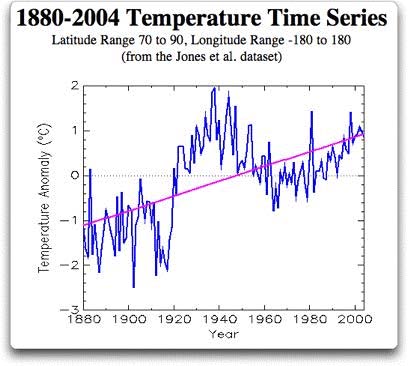
The instrument temperature records since 1850 or so (until satellite measures started in the 1970s) which are used to prove AGW (human induced global warming) have been shown to be inaccurate, unreliable, and tainted by numerous errors.
Man is actually an insignificant producer of CO2, though he is prideful enough to think he is a major player.
The greatest amount of carbon dioxide is locked up in plants, rocks, and the oceans. It should not be surprising that these each contribute more CO2 emissions than any other sources. The largest emitters of carbon dioxide are volcanic eruptions, forest and wild fires, and natural decomposition of plants and animals. This is a good thing, since there is a relatively stable and finite amount of both oxygen and carbon on this planet. If it weren’t for carbon dioxide, the earth could well be a frozen ball in space, and life, as we know it, would probably not be able to survive.
The biggest source of CO2 emissions is volcanic eruptions. At any given time, according to agencies such as the USGS, there are about 13-17 volcanoes erupting somewhere on Earth. Thankfully, ocean water has a great propensity for absorbing this gas, and as ice melts, as it has done for the past 11,000 years, it means that the oceans can take in a great deal more CO2.
Next in line for emissions is forest and wild fires and the decomposition of plant life.
The next biggest emitter of carbon dioxide is probably the ocean.
The exact figures for the amount of CO2 released through the use of fossil fuels is hard to come by.
A person may wonder where man and other animals fit into all of this. After all, animals breathe in oxygen and breath out carbon dioxide. Their bodies also contain CO2 and carbon, which is released when they die and decompose. Man also burns fossil fuels, which do release CO2 as a byproduct. However, animals including man don’t produce nearly as much carbon dioxide as the major producers, with the possible exception of the death and decomposition of animals.
Evidence for Predicting Global Cooling for the Next Three Decades
By Professor Don J. Easterbrook, Global Research November 2, 2008
INTRODUCTION
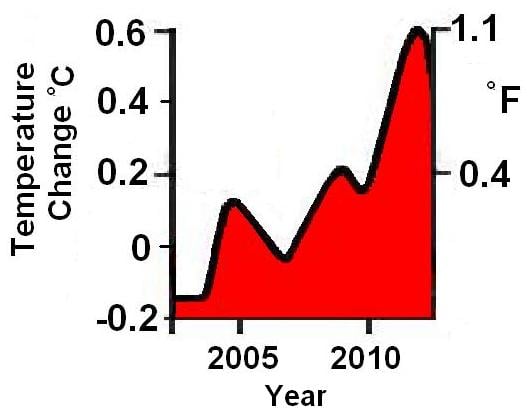
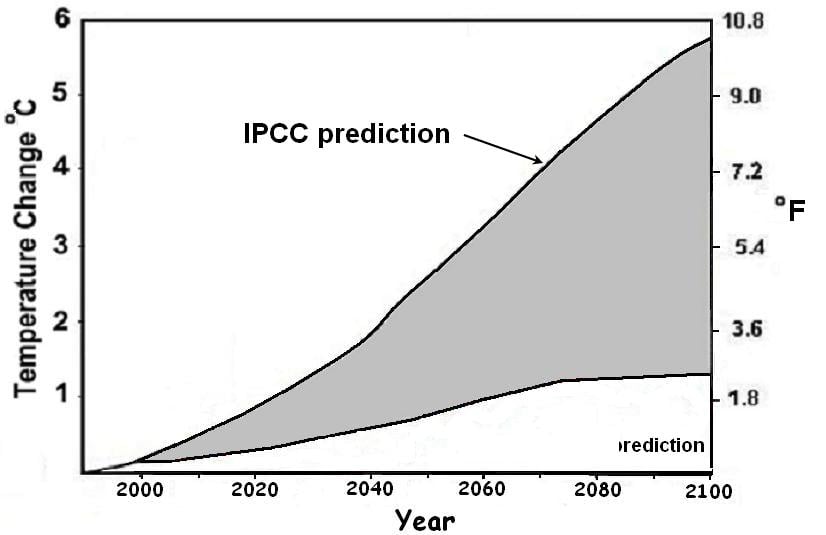
Despite no global warming in 10 years and recording setting cold in 2007-2008, the Intergovernmental Panel on Climatic Change (IPCC) and computer modelers who believe that CO2 is the cause of global warming still predict the Earth is in store for catastrophic warming in this century.
IPCC computer models have predicted global warming of 1° F per decade and 5-6° C (10-11° F) by 2100 (Fig. 1), which would cause global catastrophe with ramifications for human life, natural habitat, energy and water resources, and food production.All of this is predicated on the assumption that global warming is caused by increasing atmospheric CO2 and that CO2 will continue to rise rapidly.
Figure 1. A. IPCC prediction of global warming early in the 21st century. B. IPCC prediction of global warming to 2100. (Sources: IPCC website)
However, records of past climate changes suggest an altogether different scenario for the 21st century.Rather than drastic global warming at a rate of 0.5 ° C (1° F) per decade, historic records of past natural cycles suggest global cooling for the first several decades of the 21st century to about 2030, followed by global warming from about 2030 to about 2060, and renewed global cooling from 2060 to 2090 (Easterbrook, D.J., 2005, 2006a, b, 2007, 2008a, b); Easterbrook and Kovanen, 2000, 2001).
Climatic fluctuations over the past several hundred years suggest ~30 year climatic cycles of global warming and cooling, on a general rising trend from the Little Ice Age.
PREDICTIONS BASED ON PAST CLIMATE PATTERNS
Global climate changes have been far more intense (12 to 20 times as intense in some cases) than the global warming of the past century, and they took place in as little as 20–100 years.
Global warming of the past century (0.8° C) is virtually insignificant when compared to the magnitude of at least 10 global climate changes in the past 15,000 years. None of these sudden global climate changes could possibly have been caused by human CO2 input to the atmosphere because they all took place long before anthropogenic CO2emissions began.The cause of the ten earlier ‘natural’ climate changes was most likely the same as the cause of global warming from 1977 to 1998.
Figure 2. Climate changes in the past 17,000 years from the GISP2 Greenland ice core. Red = warming, blue = cooling. (Modified from Cuffy and Clow, 1997)
Climatic fluctuations over the past several hundred years suggest ~30 year climatic cycles of global warming and cooling (Figure 3) on a generally rising trend from the Little Ice Age about 500 years ago.
Figure 3. Alternating warm and cool cycles since 1470 AD. Blue = cool, red = warm. Based on oxygen isotope ratios from the GISP2 Greenland ice core.
Relationships between glacial fluctuations, the Pacific Decadal Oscillation, and global climate change.
After several decades of studying alpine glacier fluctuations in the North Cascade Range, my research showed a distinct pattern of glacial advances and retreats (the Glacial Decadal Oscillation, GDO) that correlated well with climate records. In 1992, Mantua published the Pacific Decadal Oscillation curve showing warming and cooling of the Pacific Ocean that correlated remarkably well with glacial fluctuations. Both the GDA and the PDO matched global temperature records and were obviously related (Fig. 4). All but the latest 30 years of changes occurred prior to significant CO2 emissions so they were clearly unrelated to atmospheric CO2.
Figure 4. Correspondence of the GDO, PDO, and global temperature variations.
The significance of the correlation between the GDO, PDO, and global temperature is that once this connection has been made, climatic changes during the past century can be understood, and the pattern of glacial and climatic fluctuations over the past millennia can be reconstructed. These patterns can then be used to project climatic changes in the future.
Using the pattern established for the past several hundred years, in 1998 I projected the temperature curve for the past century into the next century and came up with curve ‘A’ in Figure 5 as an approximation of what might be in store for the world if the pattern of past climate changes continued. Ironically, that prediction was made in the warmest year of the past three decades and at the acme of the 1977-1998 warm period.
At that time, the projected curved indicated global cooling beginning about 2005 ± 3-5 years until about 2030, then renewed warming from about 2030 to about 2060 (unrelated to CO2—just continuation of the natural cycle), then another cool period from about 2060 to about 2090. This was admittedly an approximation, but it was radically different from the 1° F per decade warming called for by the IPCC. Because the prediction was so different from the IPCC prediction, time would obviously show which projection was ultimately correct.
Now a decade later, the global climate has not warmed 1° F as forecast by the IPCC but has cooled slightly until 2007-08 when global temperatures turned sharply downward. In 2008, NASA satellite imagery (Figure 6) confirmed that the Pacific Ocean had switched from the warm mode it had been in since 1977 to its cool mode, similar to that of the 1945-1977 global cooling period. The shift strongly suggests that the next several decades will be cooler, not warmer as predicted by the IPCC.
Figure 5. Global temperature projection for the coming century, based on warming/cooling cycles of the past several centuries. ‘A’ projection based on assuming next cool phase will be similar to the 1945-1977 cool phase. ‘B’ projection based on assuming next cool phase will be similar to the 1880-1915 cool phase. The predicted warm cycle from 2030 to 2060 is based on projection of the 1977 to 1998 warm phase and the cooling phase from 2060 to 2090 is based on projection of the 1945 to 1977 cool cycle.
Implications of PDO, NAO, GDO, and sun spot cycles for global climate in coming decades
The IPCC prediction of global temperatures, 1° F warmer by 2011 and 2° F by 2038 (Fig. 1), stand little chance of being correct.NASA’s imagery showing that the Pacific Decadal Oscillation (PDO) has shifted to its cool phase is right on schedule as predicted by past climate and PDO changes (Easterbrook, 2001, 2006, 2007).
The PDO typically lasts 25-30 years and assures North America of cool, wetter climates during its cool phases and warmer, drier climates during its warm phases. The establishment of the cool PDO, together with similar cooling of the North Atlantic Oscillation (NAO), virtually assures several decades of global cooling and the end of the past 30-year warm phase. It also means that the IPCC predictions of catastrophic global warming this century were highly inaccurate.
The switch of PDO cool mode to warm mode in 1977 initiated several decades of global warming. The PDO has now switched from its warm mode (where it had been since 1977) into its cool mode. As shown on the graph above, each time this had happened in the past century, global temperature has followed. The upper map shows cool ocean temperatures in blue (note the North American west coast). The lower diagram shows how the PDO has switched back and forth from warm to cool modes in the past century, each time causing global temperature to follow.
Comparisons of historic global climate warming and cooling over the past century with PDO and NAO oscillations, glacial fluctuations, and sun spot activity show strong correlations and provide a solid data base for future climate change projections.
The Pacific Ocean has a warm temperature mode and a cool temperature mode, and in the past century, has switched back forth between these two modes every 25-30 years (known as the Pacific Decadal Oscillation or PDO).In 1977 the Pacific abruptly shifted from its cool mode (where it had been since about 1945) into its warm mode, and this initiated global warming from 1977 to 1998.
The correlation between the PDO and global climate is well established. The announcement by NASA’s Jet Propulsion Laboratory that the Pacific Decadal Oscillation (PDO) had shifted to its cool phase is right on schedule as predicted by past climate and PDO changes (Easterbrook, 2001, 2006, 2007). The PDO typically lasts 25-30 years and assures North America of cool, wetter climates during its cool phases and warmer, drier climates during its warm phases. The establishment of the cool PDO, together with similar cooling of the North Atlantic Oscillation (NAO), virtually assures several decades of global cooling and the end of the past 30-year warm phase.
Figure 6. Switch of PDO cool mode to warm mode in 1977 initiated several decades of global warming. The PDO has now switched from its warm mode (where it had been since 1977) into its cool mode. As shown on the graph above, each time this has happened in the past century, global temperature has followed. The upper map shows cool ocean temperatures in blue (note the North American west coast). The lower diagram shows how the PDO has switched back and forth from warm to cool modes in the past century, each time causing global temperature to follow. Projection of the past pattern (right end of graph) assures 30 yrs of global cooling
Comparisons of historic global climate warming and cooling over the past century with PDO and NAO oscillations, glacial fluctuations, and sun spot activity show strong correlations and provide a solid data base for future climate change projections.
As shown by the historic pattern of GDOs and PDOs over the past century and by corresponding global warming and cooling, the pattern is part of ongoing warm/cool cycles that last 25-30 years.
The global cooling phase from 1880 to 1910, characterized by advance of glaciers worldwide, was followed by a shift to the warm-phase PDO for 30 years, global warming and rapid glacier recession.The cool-phase PDO returned in ~1945 accompanied by global cooling and glacial advance for 30 years.
Shift to the warm-phase PDO in 1977 initiated global warming and recession of glaciers that persisted until 1998.
Recent establishment of the PDO cool phase appeared right on target and assuming that its effect will be similar to past history, global climates can be expected to cool over the next 25-30 years.The global warming of this century is exactly in phase with the normal climatic pattern of cyclic warming and cooling and we have now switched from a warm phase to a cool phase right at the predicted time (Fig. 5)
The ramifications of the global cooling cycle for the next 30 years are far reaching―e.g., failure of crops in critical agricultural areas (it’s already happening this year), increasing energy demands, transportation difficulties, and habitat change. All this during which global population will increase from six billion to about nine billion.
The real danger in spending trillions of dollars trying to reduce atmospheric CO2 is that little will be left to deal with the very real problems engendered by global cooling.
CONCLUSIONS
Global warming (i.e, the warming since 1977) is over. The minute increase of anthropogenic CO2 in the atmosphere (0.008%) was not the cause of the warming—it was a continuation of natural cycles that occurred over the past 500 years.
The PDO cool mode has replaced the warm mode in the Pacific Ocean, virtually assuring us of about 30 years of global cooling, perhaps much deeper than the global cooling from about 1945 to 1977.
Just how much cooler the global climate will be during this cool cycle is uncertain. Recent solar changes suggest that it could be fairly severe, perhaps more like the 1880 to 1915 cool cycle than the more moderate 1945-1977 cool cycle. A more drastic cooling, similar to that during the Dalton and Maunder minimums, could plunge the Earth into another Little Ice Age, but only time will tell if that is likely.
Don J. Easterbrook is Professor Emeritus of Geology at Western Washington University. Bellingham, WA. He has published extensively on issues pertaining to global climate change. For further details see his list of publications
By Kirk Myers, Seminole County Environmental News Examiner May 19, 2010
The Triple Crown of Global Cooling:
Cooling North Pacific sea surface temperatures (Pacific Decadal Oscillation or PDO),
Extremely low solar activity, and
Increased volcanic eruptions.
The second climate driver in the Triple Crown of Cooling is extremely low solar activity. In May 2009, we exited the longest solar minimum in 100 years —this continued stretch of weak solar activity lasted 12.7 years, compared to the 11-year average (it was a historically inactive period in terms of sunspot numbers).If the low levels of solar activity during 2006 - 2009 continue through the current solar cycle (Solar Cycle 24), which is expected to peak in 2013, we could be facing a severe temperature decline within the next five to eight years (2010 - 2018) as Earth’s climate begins to respond to the drop-off in solar activity.
“Global warming” may become one of those quaint cocktail party conversations of the past if three key climate drivers [the Triple Crown of Global Cooling]— cooling North Pacific sea surface temperatures, extremely low solar activity, and increased volcanic eruptions —converge to form a “perfect storm” of plummeting temperatures that send our planet into a long-term cool-down lasting 20 or 30 years or longer.
“There are some wild cards that are different from what we saw when we came out of the last warm PDO [Pacific Decadal Oscillation] and entered its cool phase [1947 to 1976].Now we have a very weak solar cycle and the possibility of increased volcanic activity.Together, they would create what I call the ‘Triple Crown of Cooling,’” says Accuweather meteorologist Joe Bastardi.
If all three climate-change ingredients come together, it would be a recipe for dangerously cold temperatures that would shorten the agricultural growing season in northern latitudes, crippling grain production in the wheat belts of the United States and Canada and triggering widespread food shortages and famine.
Cool Pacific Decadal Oscillation
The Pacific Decadal Oscillation refers to cyclical variations in sea surface temperatures that occur in the North Pacific Ocean. (The PDO is often described as a long-lived El Niño-like pattern.) PDO events usually persist for 20 to 30 years, alternating between warm and cool phases. During these long periods there are sometimes short-interval phase switches that can last several years.
From 1977 to 1998, during the height of “global warming,” North America was in the midst of a warm PDO.Since then, we have experienced several short-duration PDO fluctuations between cool and warm.
But the PDO has once again resumed its negative cool phase, and, as such, represents the first climate driver in the Triple Crown of Cooling. With the switch to a cool PDO, we’ve seen a change in the El Nino/Southern Oscillation (ENSO), which alternates between El Nino (warm phase) and La Nina (cool phase) every few years. The recent strong El Nino that began in July 2009 is now transitioning to a La Nina, a sign of cooler temperatures ahead.
“We’re definitely headed towards La Nina conditions before summer is over, and we’re looking at a moderate to strong La Nina by fall and winter, which, as these La Ninas tend to persist in the cold PDO for two years, should bring us cooler temperatures over the next few years,” predicts Joe D’Aleo, founder of the International Climate and Environmental Change Assessment Project (ICECAP) and the first director of meteorology at the Weather Channel.
He is not alone in his forecast. Bastardi also sees a La Nina just around the corner.
“I’ve been saying since February that we’ll transition to La Nina by the middle of the hurricane season. I think we’re already seeing the atmosphere going into a La Nina state in advance of water temperatures. This will have interesting implications down the road. La Nina will dramatically cool off everything later this year and into next year, and it is a signal for strong hurricane activity,” Bastardi predicts.
The difference in sea surface temperature between positive and negative PDO phases is not more than 1 to 2 degrees Celsius, but the affected area is huge. So the temperature changes can have a big impact on the climate in North America.
In fact, as Dr. Roy Spencer points out, the warm-phase PDO lasting from 1977 to 1998 might explain most of the warming we experienced in the late 20th century.
“This is because a change in weather circulation patterns can cause a small change in global-average cloudiness. And since clouds represent the single largest internal control on global temperatures (through their ability to reflect sunlight), a change in cloudiness associated with the PDO might explain most of the climate change we’ve seen in the last 100 years or more,” he writes.
Declining solar activity
Another real concern — and the second climate driver in the Triple Crown of Cooling — is the continued stretch of weak solar activity Earth is experiencing.We recently exited the longest solar minimum — 12.7 years compared to the 11-year average — in 100 years. It was a historically inactive period in terms of sunspot numbers. During the minimum, which began in 2004, we have experienced 800 spotless days. A normal cycle averages 485 spotless days.
In 2008, we experienced 265 days without a sunspot, the fourth-highest number of spotless days since continuous daily observations began in 1849.In 2009, the trend continued, with 261 spotless days, ranking it among the top five blank-sun years. Only 1878, 1901 and 1913 (the record-holder with 311 days) recorded more spotless days.
In 2010, the sun continues to remain in a funk. There were 27 spotless days (according to Layman’s sunspot count) in April and, as of May 19, 12 days without a spot. Both months exhibited periods of inexplicably low solar activity during a time when the sun should be flexing its “solar muscle” and ramping up towards the next solar maximum.
Why are sunspot numbers important?Very simple: there is a strong correlation between sunspot activity and global temperature.During the Dalton Minimum (1790 - 1830) and Maunder Minimum (1645 -1715), two periods with very low sunspot activity, temperatures in the Northern Hemisphere plummeted.
During the Dalton Minimum, the abnormally cold weather destroyed crops in northern Europe, the northeastern United States and eastern Canada.Historian John D. Post called it “the last great subsistence crisis in the Western world.” The record cold intensified after the eruption of Mount Tambora in 1815, the largest volcanic eruption in more than 1,600 years (see details below).
During the 70-year Maunder Minimum, astronomers at the time counted only a few dozen sunspots per year, thousands fewer than usual. As sunspots vanished, temperatures fell. The River Thames in London froze, sea ice was reported along the coasts of southeast England, and ice floes blocked many harbors. Agricultural production nose-dived as growing seasons became shorter, leading to lower crop yields, food shortages and famine.
If the low levels of solar activity during the past three years continue through the current solar cycle (Solar Cycle 24), which is expected to peak in 2013, we could be facing a severe temperature decline within the next five to eight years as Earth’s climate begins to respond to the drop-off in solar activity.
“The sun is behaving very quietly — like it did in the late 1700s during the transition from Solar Cycle 4 to Solar Cycle 5 — which was the start of the Dalton Minimum,” D’Aleo says. “If the official sunspot number reaches only 40 or 50 — a low number indicating very weak solar energy levels — during the next solar maximum, we could be facing much lower global temperatures down the road.”
"Since the Space Age began in the 1950s, solar activity has been generally high," Hathaway told NASA Science News. "Five of the ten most intense solar cycles on record have occurred in the last 50 years. We're just not used to this kind of deep calm."
Volcanic eruptions
Although the eruption of Iceland’s Mount Eyjafjallajokull volcano continues to raise havoc with air travel, it remains a relatively minor event by volcanic standards. Much of its ash cloud has stayed out of the stratosphere, where it would reflect sunlight, bringing cooler temperatures to the northern hemisphere.
Unfortunately, there is a very real chance Eyjafjallajokull’s much larger neighbor, the Katla volcano, could blow its top, creating the third-climate driver in the Triple Crown of Cooling.If Katla does erupt, it would send global temperatures into a nosedive, with a big assist from the cool PDO and a slumbering sun.
Katla erupts about every 70 years or so, most recently in 1918, often in tandem with neighboring Eyjafjallajokull, which is not a good sign.
According to Bastardi:
“The Katla volcano in Iceland is a game changer.If it erupts and sends plumes of ash and SO2 into the stratosphere, any cooling caused by the oceanic cycles would be strengthened and amplified.”
Iceland’s President Olafur Grimsson says the eruption of Eyjafjallajoekull volcano is only a "small rehearsal.”
“The time for Katla to erupt is coming close . . . I don't say if, but I say when Katla will erupt,” Grimsson predicts. And when Katla finally erupts it will “create for a long period, extraordinary damage to modern advanced society.”
Not a very encouraging outlook. Yet major eruptions throughout history bear witness to the deadly impact of volcanoes.
The Tambora eruption in 1815, the largest in 1,600 years, sent the earth’s climate into a deep freeze, triggering “the year without a summer.”Columnist Art Horn, writing in the Energy Tribune, describes the impact:
“During early June of 1815, a foot of snow fell on Quebec City. In July and August, lake and river ice were observed as far south as Pennsylvania. Frost killed crops across New England with resulting famine. During the brutal winter of 1816/17, the temperature fell to -32 in New York City.”
And Katla, with its large magma chamber, would register high on the Volcanic Explosivity Index, if it were to erupt. When it unleashed its fury in the 1700s, the volcano sent temperatures into a tailspin in North America.
As Gary Hufford, a scientist with the Alaska Region of the National Weather Service, observes:
"The Mississippi River froze just north of New Orleans and the East Coast, especially New England, had an extremely cold winter.
"Katla could cause some serious weather changes. It depends on the duration of the eruption, and how high the ash gets blasted into the stratosphere.”
Global cooling: a life-threatening event
With the PDO now in its cool phase, solar activity the weakest in more than 100 years, and the prospect of a major climate-cooling volcanic eruption,actions to limit CO2 emissions should be shelved and preparations made for an extended period of global cooling that would pose far more danger to humankind than any real or imagined warming predicted by today’s climate models.
Says D’Aleo:
“Cold is far more threatening than the little extra warmth we experienced from 1977 to 1998 during the recent warm PDO. According to NASA, crop yield decreased 30 percent, and there was a 10 percent decrease in arable land during that period, which helped us feed many millions more of the earth’s population. A cooling down to Dalton Minimum temperatures or worse would lead to shortened growing seasons and large-scale crop failures. Food shortages would make worse the fact that more people die from cold than heat.
The Pacific Decadal Oscillation (PDO) is an internal switch between two slightly different circulation patterns that occurs every 30 years or so in the North Pacific Ocean. It was originally described in 1997 in the context of salmon production. It has a positive (warm) phase that tends to warm the land masses of the Northern Hemisphere, as well as a negative (cool) phase.
Like the El Nino and La Nina oscillation of the tropical Pacific (also called the El Nino – Southern Oscillation, or ENSO), the PDO represents two different average circulation states that the ocean-atmosphere system seems to have a difficult time choosing between. But whereas ENSO changes every few years, the PDO changes every thirty years or so. This long time scale makes the PDO a potential key player in climate change.
In fact, I now believe that the PDO is critical to our understanding of global warming. This is because a change in weather circulation patterns can cause a small change in global-average cloudiness. And since clouds represent the single largest internal control on global temperatures (through their ability to reflect sunlight), a change in cloudiness associated with the PDO might explain most of the climate change we’ve seen in the last 100 years or more.
For instance, after the “Great Climate Shift of 1977″ when the PDO went from its negative to positive phase, the Arctic region began to warm. Satellite monitoring of Arctic sea ice just happened to begin soon thereafter (in 1979), and as you probably know from the news media reports, the yearly summer melt season has seen a gradual loss of ice cover since then. In late 2007, the Northwest Passage opened, a rare event that allows ships to travel the relatively short distance between the Atlantic and Pacific Oceans through the Arctic.
But while the warming and loss of Arctic sea ice in the last 30 years is popularly attributed to mankinds’ production of carbon dioxide from fossil fuel use, similar events occurred in the 1920s and 1930s, with disappearing sea ice, changing wildlife patterns, and the opening of the Northwest Passage in 1939 and 1940. Arctic temperatures were just as warm then as they are now.
And now, as of late 2008, it looks like we might have entered into a new, negative (cooling) phase of the PDO. Only time will tell whether this pattern persists.
Winters in the United States have gotten colder over the last 10 years. The reasons: a cooler Pacific Ocean (the cold phase of the Pacific Decadal Oscillation), a weak solar cycle and volcanic activity as the causes of the cooling.
NewsNet5.com July 6, 2011
The numbers don't lie. The observations don't lie. Winters in Ohio and the United States have gotten colder over the last 10 years. But you sensed that anyway, didn't you? (Especially after this last long, cold winter!)
Meteorologist & colleague Joe D'Aleo, from the website ICECAP.us, took a look at the winter statistics from the National Climatic Data Center (NCDC). What he found was startling. Since late 2001, the winter months of December, January and February have gotten colder at the second fastest 10-year rate since the late 1800s.On average, all nine official climate regions of the US have seen a wintertime temperature drop of 4.13 degrees F.
Ohio is part of the six-state Central Climate Region. That includes Illinois, Indiana, West Virginia, Kentucky and Tennessee. In this region, our temperatures have declined an impressive 5.82 degrees F since the winter of 2001/2002.
The largest decline was seen in the Northern Plains and the Western Great Lakes, where cold-season temperatures have plummeted up to 8.74 degrees F on average over the last 10 winters.
The snow pack across the Northern Hemisphere has also increased during this chilly period. This passed winter produced the third greatest snow extent (in square km) for the Northern Hemisphere since 1967. It finished behind only the winter of 2009/10 and 1977/78 and just ahead of the winter of 2007/08.
The reasons?
"Clearly, natural factors really can pack a punch," said Dr. Joe D'Aleo.
He sited a cooler Pacific Ocean (the cold phase of the Pacific Decadal Oscillation), a weak solar cycle and volcanic activity as the causes of the cooling.
Sunspot cycles -- those 11-year patterns when dark dots appear on the solar surface -- may be delayed or even go into "hibernation" for a while, a U.S. scientist said on Wednesday.
But contrary to some media reports, this does not mean a new Ice Age is coming, Frank Hill of the National Solar Observatory said in a telephone interview.
"We have not predicted a Little Ice Age," Hill said, speaking from an astronomical meeting in New Mexico. "We have predicted something going on with the Sun."
The appearance of sunspots helps predict solar storms that can interfere with satellite communications and power grids.
Hill and other scientists cited a missing jet stream, fading spots and slower activity near the Sun's poles as signs that our nearest star is heading into a rest period.
"This is highly unusual and unexpected," he said in a statement released on Tuesday. "But the fact that three completely different views of the Sun point in the same direction is a powerful indicator that the sunspot cycle may be going into hibernation."
That hibernation would not begin now, as the current sunspot cycle, the 24th, has recently passed its minimum. Hill and his colleagues pondered a slowdown in sunspot activity in the 25th cycle, expected sometime around 2019.
They also wondered whether this possible slowdown, or even a long cessation of sunspot activity, indicates an upcoming return of the Maunder Minimum, a 70-year sunspot drought seen from 1645-1715.
'HUGE LEAP'
They had no answer as to whether this might be true, and said nothing about whether the Maunder Minimum -- named for astronomer E.H. Maunder -- was related to a long cold period in Europe and other parts of the Northern Hemisphere known as the Little Ice Age.
How strong a connection is there between a Little Ice Age and a Maunder Minimum?
"Not as strong a connection as people would like to believe," Hill said by phone.
"The Little Ice Age actually lasted for hundreds of years, of which the Maunder Minimum was only a small segment ... My personal opinion is that there is only an anecdotal connection without a whole lot of scientific background behind it."
Several websites and blogs have argued that the potentially cooling influence of a lower level of sunspot activity could cancel out the warming caused by human activities that generate climate-warming greenhouse gases.Hill disputed this.
"In my opinion, it is a huge leap ... to an abrupt global cooling, since the connections between solar activity and climate are still very poorly understood," he said in an e-mail.
US scientists say the familiar sunspot cycle seems to be entering a hibernation period unseen since the 17th century, a pattern that could have a slight cooling effect on global temperatures.
For years, scientists have been predicting the Sun would by around 2012 move into solar maximum, a period of intense flares and sunspot activity,but lately a curious calm has suggested quite the opposite.
The signs include a missing jet stream, fading spots and slower activity near the poles, said a trio of studies presented Tuesday at the annual meeting of the American Astronomical Society's Solar Physics Division in Las Cruces, New Mexico.
"This is highly unusual and unexpected," said Frank Hill, associate director of the National Solar Observatory's Solar Synoptic Network.
"But the fact that three completely different views of the Sun point in the same direction is a powerful indicator that the sunspot cycle may be going into hibernation."
Solar activity tends to rise and fall every 11 years or so. The solar maximum and solar minimum each mark about half the interval of the magnetic pole reversal on the Sun, which happens every 22 years.
Experts are now probing whether this period of inactivity could be a second Maunder Minimum, a 70-year period when hardly any sunspots were observed between 1645-1715 known as the "Little Ice Age."
"If we are right, this could be the last solar maximum we'll see for a few decades. That would affect everything from space exploration to Earth's climate," said Hill.
Solar flares and eruptions can send highly charged particles hurtling toward Earth and interfere with satellite communications, GPS systems and even airline controls.
Geomagnetic forces have been known to occasionally garble the world's modern gadgetry, and warnings were issued as recently as last week when a moderate solar flare sent a fiery coronal mass ejection in the Earth's direction.
However, the temperature change associated with any reduction in sunspot activity would likely be minimal and not enough to offset the impact of greenhouse gases on global warming, according to scientists.
"Recent solar 11-year cycles are associated empirically with changes in global surface temperature of 0.1 Celsius," said Judith Lean, a solar physicist with the US Naval Research Laboratory.
If the cycle were to stop or slow down, the small fluctuation in temperature would do the same, eliminating the slightly cooler effect of a solar minimum compared to the warmer solar maximum. The phenomenon was witnessed during the descending phase of the last solar cycle.
This "cancelled part of the greenhouse gas warming of the period 2000-2008, causing the net global surface temperature to remain approximately flat -- and leading to the big debate of why the Earth hadn't (been) warming in the past decade," Lean, who was not involved in the three studies presented, told AFP.
Less sunspot activity means the Sun will radiate lower levels of energy, ultraviolet rays, solar wind and a weaker magnetic field, explained climate scientist and author Rasmus Benestad of the Norwegian Meteorological Institute.
"Historical data suggest that solar activity, however, only appears to have a weak effect on our climate," said Benestad.
A study in the March 2010 issue of Geophysical Research Letters explored what effect an extended solar minimum might have, and found no more than a 0.3 Celsius dip by 2100 compared to normal solar fluctuations.
"A new Maunder-type solar activity minimum cannot offset the global warming caused by human greenhouse gas emissions," wrote authors Georg Feulner and Stefan Rahmstorf, noting that forecasts by the Intergovernmental Panel on Climate Change forecast a maximum 4.5 degree Celsius rise by this century's end compared to the latter half of the 20th century.
"Moreover, any offset of global warming due to a grand minimum of solar activity would be merely a temporary effect, since the distinct solar minima during the last millennium typically lasted for only several decades or a century at most."
Other experts were skeptical about whether the latest data actually predict a long-term solar minimum.
"There is no compelling reason to think that the Sun is about to go into hibernation," said Yi-Ming Wang of the Naval Research Laboratory.
"On the other hand, we don't understand the solar dynamo well enough to make any reliable prediction about what cycle 25 will be like."
The New World Order Plan is spiritually based: it is a conflict between God and His forces, on the one hand, and Satan and his demonic forces on the other side. Anyone who does not know Biblical doctrine about God and Satan, and who does not know Scriptural prophecy, cannot comprehend the nature of the struggle facing the world today. - David Bay, Cutting Edge Ministries
For we wrestle not against flesh and blood, but against principalities, against powers, against the rulers of the darkness of this world, against spiritual wickedness in high places. - Ephesians 6:12
Now the brother shall betray the brother to death, and the father the son; and children shall rise up against their parents, and shall cause them to be put to death. And ye shall be hated of all men for my name’s sake: but he that shall endure unto the end, the same shall be saved. - Mark 13:12,13
For we are opposed around the world by a monolithic and ruthless conspiracy that relies on covert means for expanding its sphere of influence... Its preparations are concealed, not published. Its mistakes are buried, not headlined. Its dissenters are silenced, not praised. No expenditure is questioned, no rumor is printed, no secret is revealed. - President John F. Kennedy, April 27, 1961
The book in which they are embodied was first published in the year 1897 by Philip Stepanov for private circulation among his intimate friends. The first time Nilus published them was in 1901 in a book called The Great Within the Small and reprinted in 1905. A copy of this is in the British Museum bearing the date of its reception, August 10, 1906. All copies that were known to exist in Russia were destroyed in the Kerensky regime, and under his successors the possession of a copy by anyone in Soviet land was a crime sufficient to ensure the owner's of being shot on sight. The fact is in itself sufficient proof of the genuineness of the Protocols. The Jewish journals, of course, say that they are a forgery, leaving it to be understood that Professor Nilus, who embodied them in a work of his own, had concocted them for his own purposes.
Fair Use Notice
This site contains copyrighted material, the use of which has not always been specifically authorized by the copyright owner. We are making such material available in our efforts to advance understanding of environmental, political, human rights, economic, democracy, scientific, and social justice issues, etc. We believe this constitutes a ‘fair use’ of any such copyrighted material as provided for in section 107 of the US Copyright Law. In accordance with Title 17 U.S.C. Section 107, the material on this site is distributed without profit to those who have expressed a prior interest in receiving the included information for research and educational purposes. For more detailed information go to: http://www.law.cornell.edu/uscode/17/107.shtml.

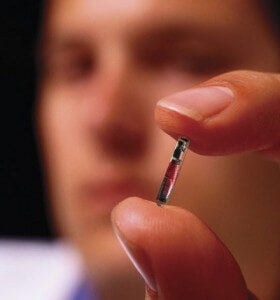 The VeriChip is the first radio-frequency identification (RFID) microchip that’s been